

 English


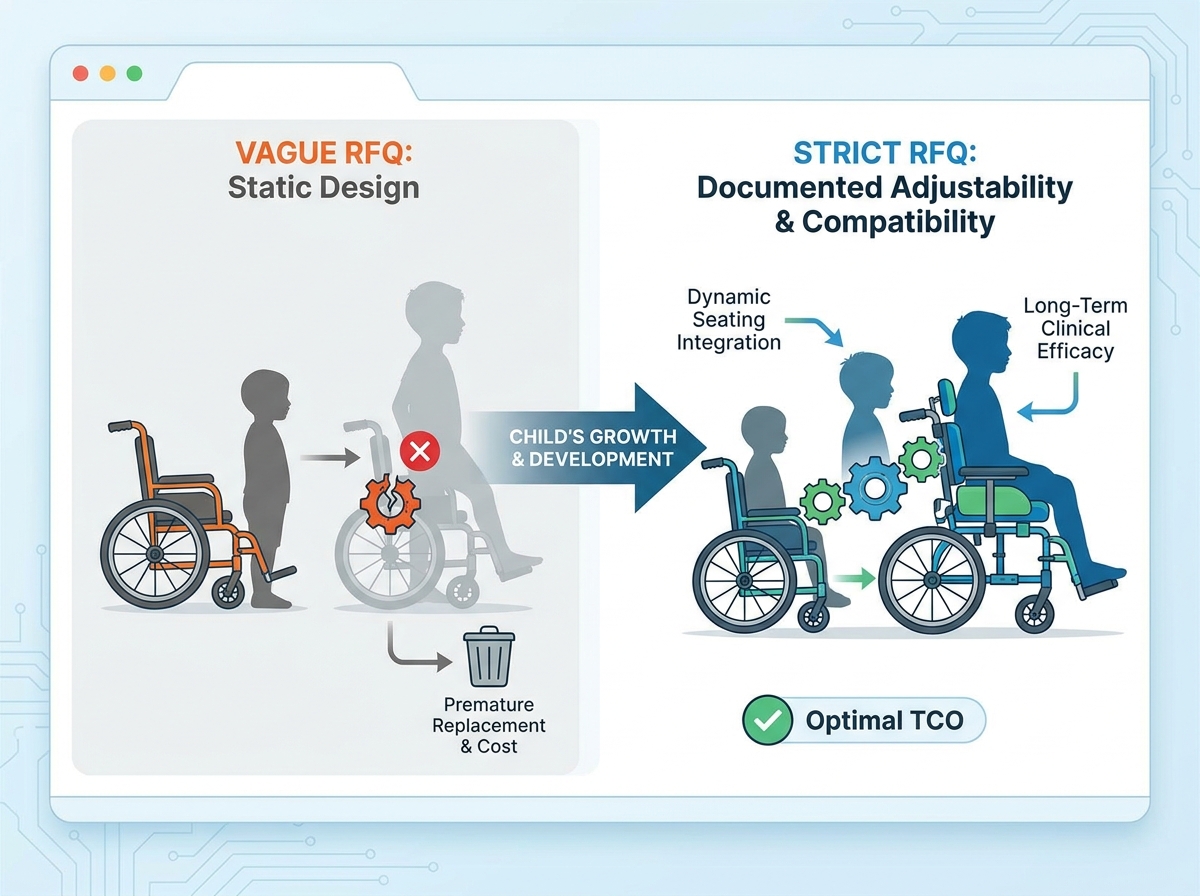
Procuring mobility equipment for growing children merges strict clinical requirements and complex financial calculations. You cannot rely on standard procurement templates. They often fail to capture developmental nuances and postural support needs. Vague Requests for Quote (RFQs) cause significant problems down the line. Buyers often acquire pediatric mobility devices requiring premature, costly replacement. Sometimes, these devices simply fail to integrate alongside medically necessary secondary postural supports. We must change how we specify this equipment. Structuring RFQs to explicitly demand measurable adjustability thresholds ensures long-term clinical efficacy. You must also demand verified third-party seating compatibility before finalizing a purchase. This guide reveals how to draft robust RFQs. We will explore exact metrics for growth capability. You will learn to properly evaluate dynamic seating needs. We will also discuss partnering directly with manufacturers to meet complex institutional demands.
Key Takeaways
Strict RFQ documentation of built-in adjustability directly reduces the lifetime cost of pediatric wheelchairs by preventing premature equipment abandonment.
Compatibility with dynamic seating and aftermarket postural supports must be established via measurable technical tolerances, not theoretical claims.
Partnering with specialized wheelchair OEM and ODM services allows institutional buyers to customize specifications at the manufacturing level rather than relying on expensive aftermarket modifications.
Evaluation criteria should heavily weight compliance with transit safety standards (WC19) and medical necessity documentation guidelines to support reimbursement and institutional liability standards.
The Business and Clinical Case for Strict RFQ Frameworks
Buyers face a high risk of denied claims. They often waste capital when purchasing pediatric wheelchairs lacking documented lifecycle adaptability. A successful RFQ objectively aligns the mechanical lifespan of the chair. It must match the anticipated physiological growth of the child. It must also support the progressive clinical needs of the pediatric patient. Equipment specifications must mirror the rigorous medical policies used by payers. For instance, funding approval often requires specific degrees of tilt, recline, or modularity. We need to frame these requirements as strict technical tolerances.
You cannot accept theoretical claims of growth potential. Institutional buyers must define success clearly in their procurement documents. A successful procurement cycle results in equipment functioning safely over multiple growth spurts. It reduces the administrative burden of frequent replacement applications. Best practices involve consulting clinical engineering specialists during the early RFQ drafting phase. We see a common mistake repeatedly. Purchasers often copy standard adult wheelchair specifications and apply them to pediatric orders. Adult specs completely fail to address pediatric growth trajectories. You should audit past procurement cycles in your facility. Identify where equipment failed early due to inadequate adjustability. Use this historical data to justify stricter RFQ criteria.
Specifying Adjustability: Growth Metrics and Modularity
We must outline the necessity of defining exact dimensional growth ranges. You should specify the minimum and maximum width or depth expansion in inches or centimeters. These adjustments must happen within the core frame itself. They should never require complete replacement of the mobility base. RFQs must clearly differentiate between built-in expansion capabilities and aftermarket growth kits.
Table 1: Comparison of Built-in Expansion vs. Aftermarket Growth Kits
| Feature Category | Built-in Frame Expansion | Aftermarket Growth Kits |
Implementation Time | Immediate clinical adjustment | Requires scheduled maintenance and lead times |
Labor Required | Low to moderate tool usage | High effort, often requiring engineering support |
Financial Impact | Included in initial purchase | Requires secondary funding approval |
Structural Risk | Engineered into baseline design | Potential alignment issues post-installation |
Frame-Level Adjustability
Demand precise specifications on cross-brace adjustments. Require detailed dimensions for telescoping frame tubes. Ask for axle plate adjustability metrics. These specific features determine the foundational adaptability of the mobility base. Clinicians rely heavily on axle plate adjustments to maintain optimal center of gravity as the child grows.
Aftermarket Growth Kits
Vendors must document the explicit cost of post-purchase growth kits. They must specify the lead time for acquiring these parts. They also need to detail the clinical effort required for installation. Some kits require hours of complex labor. We need to avoid hidden maintenance delays ruining clinical outcomes.
You must demand evidence-oriented evaluation processes. Require vendors to supply engineering documentation. They might provide clinical white papers instead. This documentation must prove structural integrity remains intact at maximum extension. Frames under maximum load often show signs of stress. We must demand concrete proof of structural safety before signing any procurement contracts.
Evaluating Dynamic Seating and Third-Party Compatibility
A custom pediatric wheelchair often requires integration alongside highly specialized third-party systems. You might use custom-molded seating, specialized headrests, or dynamic backrests. This integration presents a major compatibility challenge for clinical teams. When parts clash, therapeutic goals suffer. Poor integration can also create severe safety hazards.
RFQs must explicitly ask for load-bearing tolerances. We need extensive hardware compatibility details for dynamic seating components. These vital components absorb tone and involuntary movement. A child exhibiting strong extensor spasms can easily fracture inferior frame tubing. We recommend stating exact peak-force absorption requirements within your RFQ documents.
Hardware clearances represent another crucial evaluation metric. Require vendors to disclose all known hardware conflicts. Their mobility bases might clash against leading industry seating systems. This transparency prevents costly surprises during final equipment delivery. A common mistake is assuming universal mounting hardware fits every tubular frame. It rarely does. Always ask for an integration matrix.
Safety and compliance documentation remains non-negotiable. Mandate documentation proving WC19 transit safety compliance. The base must maintain this compliance when combined using third-party seating. A child riding in an adapted school van relies entirely on this safety standard. Modifying a chair improperly can void WC19 compliance immediately. This scenario creates severe institutional liability risks.
Leveraging Wheelchair OEM and ODM Services for Institutional Procurement
Purchasing off-the-shelf models may not meet localized clinical requirements. It often fails B2B buyers like hospital networks or international distributors. These buyers handle massive procurement volumes. Engaging wheelchair OEM and ODM services provides massive advantages. Institutional buyers can write RFQs dictating specific materials and weight limits. They can control adjustment mechanisms right at the manufacturing source.
Working directly alongside manufacturers eliminates the middleman markup on custom parts. You can engineer solutions tailored specifically to your patient demographic. For example, a specialized clinical center might require unique tilt-in-space mechanisms. An OEM partner can integrate this requirement directly into the baseline design. This approach creates a highly scalable solution for large DME dealers.
Quality Assurance (QA) Protocols
You must evaluate potential ODM partners rigorously. Require comprehensive ISO 13485 certification. Ask for their complete FDA or MDR regulatory compliance history. These certifications guarantee baseline manufacturing quality. They prove the manufacturer understands the strict regulatory environment governing medical devices. We strongly advise rejecting bids from factories lacking dedicated medical device QA protocols.
Prototype and Customization Lead Times
Establish highly acceptable timelines in your RFQ. Translating clinical feedback into engineering prototypes takes time. We must know the vendor's exact turnaround capabilities. Ask them how long they take to implement design revisions. Quick iteration cycles are critical when developing customized mobility bases for specialized pediatric populations.
Implementation Realities, Risks, and Shortlisting Logic
The primary risk in pediatric mobility procurement involves a severe disconnect. We often see engineering specifications looking perfect on paper. However, the reality of clinical adjustments in the field tells a different story. Field adjustments sometimes require excessive tools or time. If a therapist needs forty minutes to adjust seat depth, the design has failed. We must prioritize user-friendly adjustability.
Demand highly transparent warranty terms. These warranties must specifically cover high-wear mechanisms. Growth adjustments and dynamic seating hardware face immense daily strain. Parts fail prematurely without robust engineering. Ensure the warranty covers the labor costs associated with replacing these complex mechanisms.
To ensure a rigorous evaluation process, follow these strict shortlisting next steps:
Filter out vendors lacking verified third-party seating compatibility lists.
Request physical demo units for clinical staff to test adjustability complexity.
Audit the vendor’s historical data on parts availability and supply chain resilience for growth kits.
These three steps drastically reduce post-purchase friction. They force vendors to prove their claims before securing the contract. We highly recommend forming a cross-functional committee to evaluate the physical demo units. Include physical therapists, seating technicians, and procurement officers.
Conclusion
Drafting an effective pediatric wheelchair RFQ requires moving beyond basic dimensional requests. You must demand rigorous proof of modular growth and seating system interoperability. The clinical needs of growing children demand highly adaptable solutions. Prioritize vendors offering transparent compatibility matrices. Utilize OEM/ODM partnerships to strictly control manufacturing tolerances and lifecycle costs. We highly recommend consulting a clinical engineering specialist before releasing your document. You can also download a standardized pediatric adjustability RFQ template to quickly refine your next procurement cycle. Take action today to protect your capital and improve clinical outcomes.
FAQ
Q: What is the standard growth range to require in a pediatric wheelchair RFQ?
A: A standard benchmark is a minimum of 2 to 3 inches of adjustability in seat width and 3 to 4 inches in seat depth without necessitating a complete frame replacement.
Q: How do we verify seating compatibility before finalizing a purchase?
A: RFQs should require the vendor to provide an integration matrix or engineering letters of compatibility detailing successfully tested combinations of their mobility base with specific third-party seating brands.
Q: What is the difference between OEM and ODM in wheelchair procurement?
A: OEM (Original Equipment Manufacturer) produces chairs based on the buyer's exact specifications, whereas ODM (Original Design Manufacturer) provides an existing base design that the buyer can rebrand or modify for their specific market or institutional needs.
Q: Why is WC19 compliance critical for pediatric wheelchair configurations?
A: WC19 ensures the wheelchair functions safely as a seat in a motor vehicle. Modifying a chair with incompatible aftermarket seating or growth kits can void this compliance, creating severe liability and safety risks.

Get our 2026 Product Catalogue & Book a VIP Meeting
Leave your contact information and our online customer service will contact you shortly.
Reserve a 15-min VIP Consultation with our Engineering Lead. The number of places is limited.
