

 English


The mobility aid market is increasingly shifting toward multi-functional equipment. Modern consumers and healthcare facilities demand versatility. This preference drives a massive surge in 2-in-1 hybrids. They effectively eliminate the need for end-users to purchase separate devices. However, this dual functionality presents a complex dilemma for medical equipment distributors. Hybrid designs optimize inventory by replacing two distinct SKUs with one. Yet, they inherently introduce compounding points of mechanical failure. A device might function perfectly as a standard walker. That same device might buckle under the heavy structural stress of being pushed as a chair. You need a rigorous evaluation framework to thoroughly assess these devices across both functional modes. This comprehensive guide equips B2B buyers with exact vetting criteria. You will learn how to ensure clinical credibility, minimize costly warranty claims, and confidently protect your business margins.
Key Takeaways
Dual-Verification is Mandatory: Distributors must independently validate load-bearing capabilities and stability for *both* user-propelled and caregiver-pushed modes.
Transition Mechanisms are the Primary Risk: Tool-free conversion points (swing-away footrests, reversible backrests) represent the highest statistical risk for mechanical failure and user injury.
Bariatric Segmentation Matters: Expanding into high-weight-capacity models requires distinct structural evaluations, as standard aluminum frames rarely scale safely without reinforcement.
Standardization Simplifies Sourcing: Prioritizing ISO and FDA/CE compliant models streamlines procurement and mitigates liability risks.
Evaluating the Business Case for Rollator Transport Chairs
End-users and clinical facilities constantly face severe budget constraints. They also struggle with strict storage limitations in residential and medical settings. These two factors directly drive the market demand for consolidated mobility aids. Stocking a reliable line of rollator transport chairs makes undeniable financial sense. The market clearly favors versatility over single-use clinical tools.
Distributors achieve several critical success criteria when they transition to hybrid models. You must evaluate these metrics to justify the initial procurement investment.
Reduction in redundant SKUs: You stock one hybrid unit instead of managing inventory for two distinct products. This frees up valuable warehouse footprint.
High cross-sell potential: You can aggressively target aging-in-place initiatives. Post-operative care facilities also eagerly adopt these versatile units for patient discharge programs.
Low return and warranty claim rates: You should target an annual defect rate below 2%. High defect rates destroy profit margins rapidly.
Market positioning requires a careful, strategic balance. You must weigh the premium wholesale pricing of hybrid units carefully. Compare this against the combined retail cost of purchasing a standalone walker and a separate transport chair. Your sales team must clearly communicate this inherent value proposition to retail partners. A slightly higher upfront cost for a hybrid saves the end-user significant money overall.
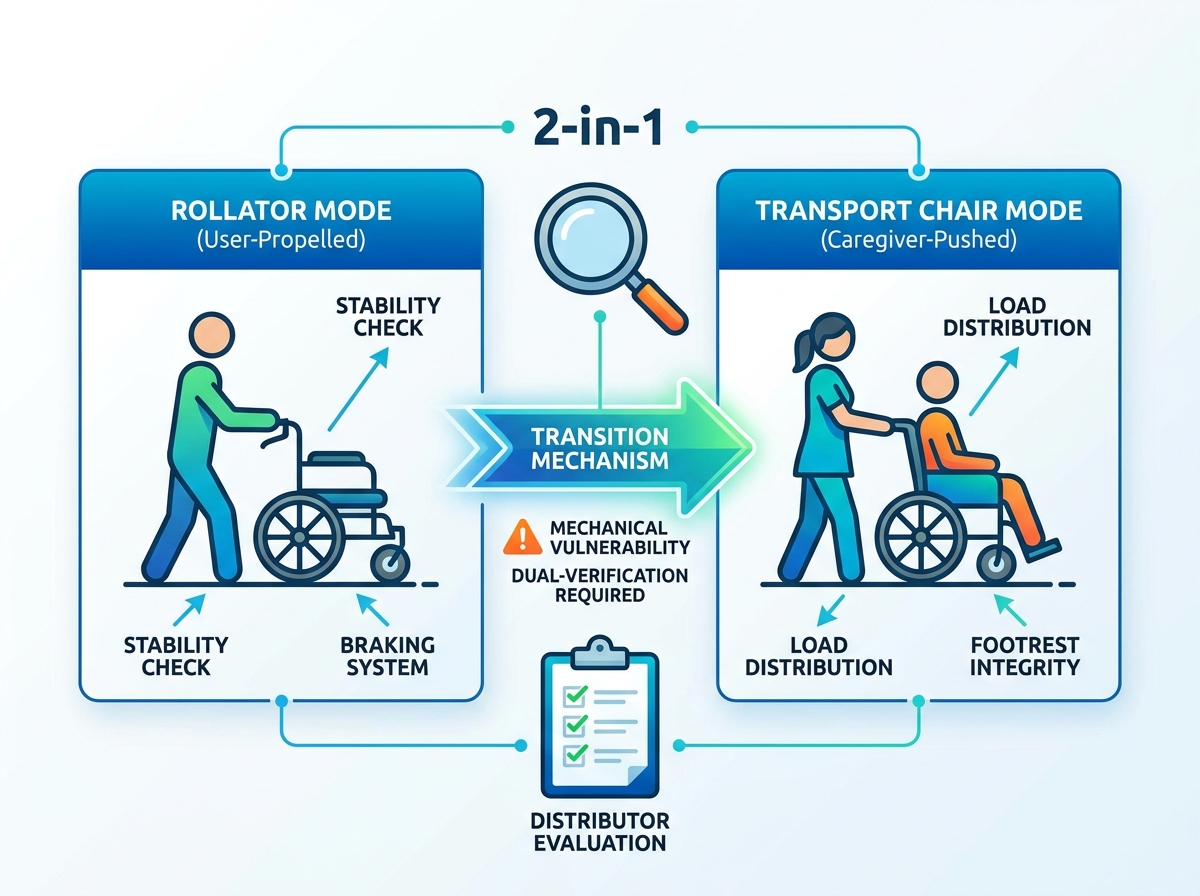
Assessing Rollator Mode: Independence, Ergonomics, and Braking
A hybrid device must first operate flawlessly as a walker. Users rely on this specific mode for daily independence and active gait training. We must translate specific mechanical features into predictable, safe patient outcomes. A failure in this primary mode renders the entire device useless.
Evaluate the loop-lock braking systems carefully. The brakes must respond instantly to light grip pressure. The locking mechanism must hold the rear wheels securely during seated resting. You cannot accept any cable slippage here. Cable stretch over time leads to dangerous roll-aways. Insist on pre-stretched, heavy-duty brake cables from your manufacturing partners.
Next, inspect the wheel base and caster dynamics. An 8-inch minimum wheel diameter is absolutely required for safe outdoor use. This specific size guarantees smooth maneuverability over uneven surfaces like gravel or cracked sidewalks. Assess the front casters for flutter at higher walking speeds. Poor quality wheel bearings cause dangerous vibrations. These vibrations travel up the frame and fatigue the user's hands rapidly.
Finally, examine the handle height adjustability mechanisms. Ensure the locking pins do not compromise structural integrity. Weak push-pins can warp the vertical frame tubing over time. The handle grips must remain rigidly fixed without any lateral twisting.
Risk mitigation is critical during active gait training. Always check for sudden center-of-gravity shifts. The chair must not tip backward. Users often lean heavily on the handles when they become fatigued. The rear wheelbase must extend far enough to counter this intense downward force safely.
Assessing Transport Chair Mode: Caregiver Control and Load Distribution
Transport mode shifts physical control from the patient to the caregiver. This mechanical transition dramatically alters how the frame handles physical stress. We must evaluate this mode through the lens of caregiver ergonomics and total load distribution.
Caregiver push handles must offer sufficient structural leverage. Caregivers desperately need this leverage to navigate thresholds, curbs, and steep ADA ramps. They perform these maneuvers while bearing the full body weight of the patient. If the handle frame flexes during a curb-climb, the aluminum tubing will eventually snap.
Footrest integration represents another critical failure point. Swing-away or fold-down footrests must lock rigidly into place. Dragging footrests are a primary cause of transport-mode accidents. Loose footrest brackets can catch on uneven pavement and violently eject the user forward. Check the locking tabs for metal construction. Plastic tabs break far too easily under impact.
Weight distribution changes completely in transport mode. A standard rollator distributes weight heavily through the user's legs. Transport mode places 100% of the user's weight directly on the seat sling. The central cross-brace absorbs all this kinetic energy. The frame must not bow inward when fully loaded.
When expanding your catalog, consider heavier demographics carefully. Sourcing a reliable bariatric rollator transport chair requires extra diligence. Distributors must absolutely verify heavy-duty steel or reinforced aluminum cross-frames. You need wider seating clearances to prevent painful pressure sores. Upgraded wheel bearings are mandatory. They must handle dynamic capacities exceeding 400 lbs safely across rough terrain.
The Transition Mechanism: Identifying Mechanical Vulnerabilities
The transition mechanism bridges the two functional modes. Unfortunately, it also represents the most vulnerable mechanical zone on the entire device. End-users are often elderly. They typically have limited manual dexterity, grip strength, or severe arthritis. The conversion between modes must be highly intuitive. It must require minimal physical force to execute correctly.
You must evaluate several mechanical dimensions during the sourcing process. First, test the reversible backrests. Inspect the locking hinges closely. Plastic joints are highly prone to snapping. Thermal stress from outdoor sun exposure degrades plastic quickly. Cold weather makes it brittle. You must demand metal-reinforced joints from your manufacturers to ensure long-term durability.
Second, inspect hardware tolerance at all pivot points. Look for signs of sheer stress on rivets and bolts. Over time, constant vibrations from outdoor use loosen conversion hardware. A loose hinge leads directly to catastrophic frame failure while the device is in motion.
Complex transitions introduce severe adoption risks. If the conversion process is confusing, user error skyrockets. Misaligned parts frequently result in falls. These falls inevitably trigger costly liability claims against the distributor. Keep the transition tool-free, visually obvious, and structurally rigid. If a user needs an instruction manual to flip the backrest, the design is inherently flawed.
Case in Point: Analyzing the BME885 Rollator Transport Chair
We can apply this theoretical framework to specific, real-world models. We will use the BME885 rollator transport chair as an excellent evaluation baseline. It represents a highly capable mid-tier hybrid model. Analyzing its features helps distributors set practical benchmarks.
You must maintain transparent assumptions during procurement. Models in this class offer highly cost-effective dual functionality. However, distributors must verify the exact gauge of the aluminum frame. Thinner aluminum gauges save shipping weight but compromise transport stability. We expect a minimum of 1.5mm to 2mm wall thickness on load-bearing tubes.
You must perform specific structural checks on any mid-tier unit before mass procurement.
Review the BME885’s footrest attachment durability. The mounting pins must resist sheer force when bumped into walls.
Assess the nylon or PVC seat longevity. Continuous transport use stretches the fabric. Look for double-stitched seams and reinforced mounting grommets.
Evaluate the brake cable routing. Internal routing prevents cables from snagging on furniture. It also prevents cables from pinching during the transition phase.
Mid-Tier Hybrid Evaluation Metrics
| Component | Evaluation Focus | Acceptable Standard |
Aluminum Frame | Wall thickness & stress points | Minimum 1.5mm gauge; double cross-brace |
Brake Cables | Routing & tension hold | Internally routed; pre-stretched steel wire |
Backrest Hinge | Material & locking action | Metal-reinforced; audible click upon locking |
Front Casters | Flutter resistance & size | 8-inch diameter; dual sealed steel bearings |
Compliance, Liability, and Supplier Shortlisting Logic
Protecting your distribution business requires strict vendor vetting. Security and compliance are absolutely non-negotiable in the medical equipment sector. You must demand technical testing documentation for ISO 11199-2. This specific international standard governs walking aids manipulated by both arms. You also need ISO 7176 documentation. This standard governs manual wheelchairs. A true hybrid must pass both testing protocols.
Verify FDA Class 1 Registration if you are selling within the US market. Verify CE MDR compliance for European markets. Ensure the manufacturing factory holds valid quality management certificates. ISO 13485 is the gold standard for medical device manufacturing.
Your shortlisting next steps must be highly methodical. Skip these steps, and you invite massive liability.
Sample Testing: Never order in bulk based solely on shiny spec sheets. Order physical samples immediately. Subject them to maximum-weight dynamic load testing. Test them on ramp descents, curb drops, and uneven outdoor terrain.
Warranty Terms: Negotiate highly explicit terms with the factory. You must clearly differentiate the replacement of moving parts from the static frame. Moving parts include brakes, wheels, and backrest hinges. Ensure the factory covers premature hinge failure.
After-Sales Support: Ensure the manufacturer provides accessible, exploded-view spare parts catalogs. Your local repair operations depend heavily on rapid parts availability. If you cannot get a replacement footrest quickly, the entire chair becomes useless inventory.
Conclusion
Sourcing 2-in-1 mobility aids requires a critical dual-lens approach. A product is truly only as viable as its weakest mode. You cannot accept compromises in stability just to gain functionality. Distributors who rigorously vet the structural integrity of transition points will win the market. You must demand stringent compliance documentation from all overseas and domestic suppliers. Test the equipment extensively for real-world caregiver ergonomics before signing bulk contracts.
Take these immediate action steps to secure your catalog:
Audit your current hybrid inventory against the dual-mode physical stress test.
Update your vendor compliance checklists to strictly include both rollator and wheelchair ISO testing standards.
Train your internal sales teams to properly educate buyers on transition mechanism safety and maintenance.
Distributors who diligently follow these steps will secure a highly profitable position. You will maintain a low-risk profile in the rapidly growing hybrid mobility market.
FAQ
Q: What is the standard weight capacity a distributor should expect for a base-model 2-in-1 rollator transport chair?
A: Base models typically support 250–300 lbs safely. Anything designed for users above 300 lbs should be explicitly tested and marketed as a bariatric model. These higher-capacity units require a reinforced double cross-brace and thicker aluminum tubing.
Q: How do warranty claim rates on hybrids compare to standard rollators?
A: Historically, hybrids see a 15-20% higher claim rate than standard walkers. These claims are primarily localized to the reversible backrest hinges and removable footrest brackets. Sourcing from factories that use metal-reinforced joints greatly mitigates this issue.
Q: Can these chairs be billed under standard Medicare/Insurance codes?
A: Coding varies widely by region. In the US, HCPCS codes dictate reimbursement. Distributors must carefully verify if the specific hybrid model qualifies under standard walker codes, wheelchair codes, or requires distinct hybrid classification. This classification directly impacts your clinical sales volume.

Get our 2026 Product Catalogue & Book a VIP Meeting
Leave your contact information and our online customer service will contact you shortly.
Reserve a 15-min VIP Consultation with our Engineering Lead. The number of places is limited.
