

 English


Sourcing manual medical equipment requires balancing tight budgets against strict clinical necessities. Buyers often face tough decisions when outfitting care facilities. You need reliable options to serve patients without exhausting financial resources.
Manual hospital beds remain a staple in clinical wards and home care because they offer long-term reliability. However, choosing the wrong configuration directly impacts patient recovery and compromises caregiver safety. The transition from a 2-crank to a 3-crank model hinges on a single, vital feature: vertical height adjustment.
This article provides a rigorous evaluation framework for purchasing managers and care coordinators. We will help you verify mechanical specifications and match bed functions to exact clinical realities. You will learn how to avoid over-purchasing while securing the safest hardware for your facility.
Key Takeaways
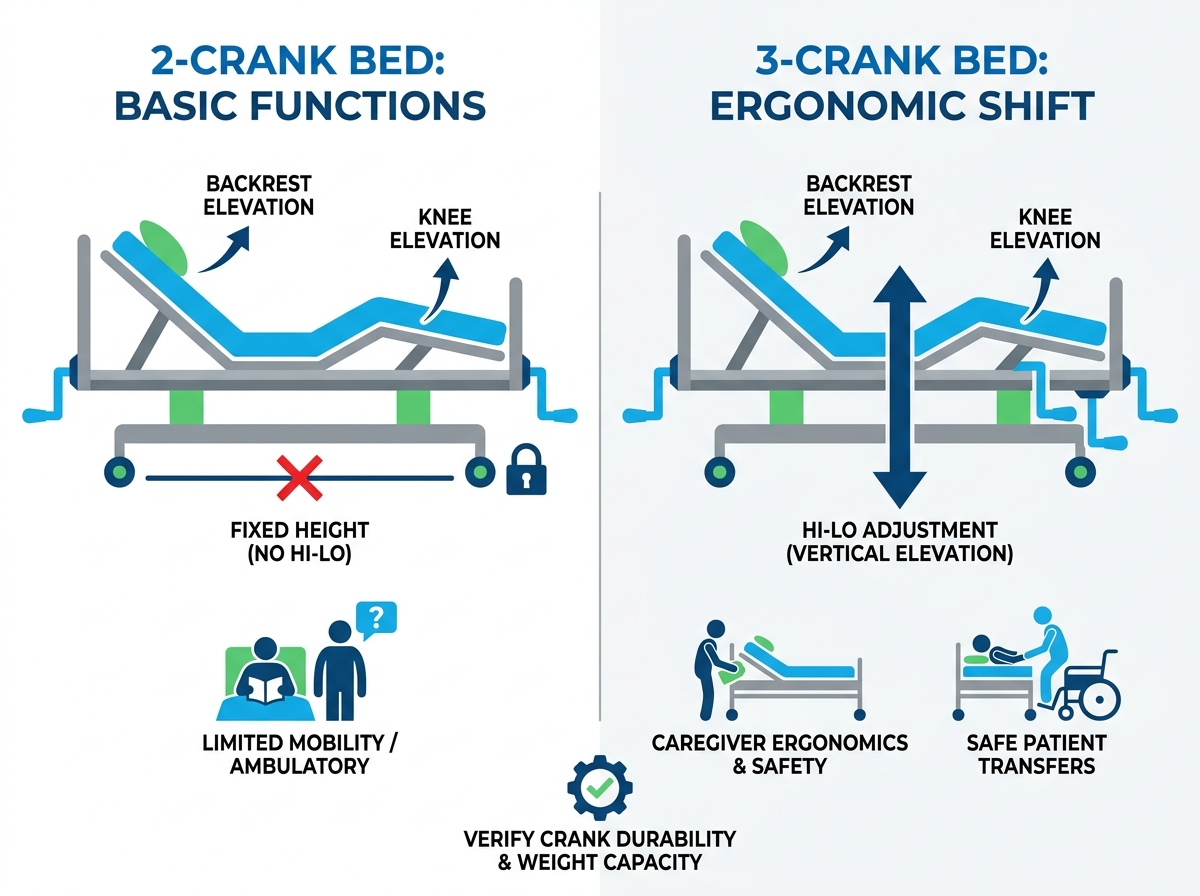
The Baseline: 2-crank beds manage head and knee elevation, suitable for patients with some mobility and standard care needs.
The Ergonomic Shift: 3-crank beds introduce Hi-Lo (height) adjustment, critical for caregiver ergonomics and safe patient transfers.
Verification is Key: Buyers must audit crank durability, weight capacities, and mattress compatibility before finalizing procurement.
Understanding the Mechanical Baseline: What Do the Cranks Actually Do?
Evaluating manual beds requires a clear understanding of mechanical capabilities. Each crank operates a specific structural zone. Let us examine how these mechanisms function in daily care settings.
The 2-Crank Configuration (Two-Function Manual Hospital Bed)
A standard two-function manual hospital bed provides essential articulation. It relies on two distinct mechanical gears. Caregivers rotate these cranks to adjust the patient's resting posture.
Function 1 manages backrest elevation. Elevating the torso aids digestion during feeding. It also improves respiratory function for patients facing breathing difficulties. Furthermore, an upright position allows patients to read or watch television comfortably. This simple adjustment prevents the complications of prolonged flat resting.
Function 2 controls knee and leg elevation. Raising the knees prevents the patient from sliding down toward the footboard. This crucial function reduces skin friction. Improved lower extremity circulation also prevents blood pooling in the legs.
However, this configuration has strict use case limits. The bed remains at a fixed vertical height. It cannot lower to the floor or raise to waist level. Therefore, these models best suit facilities or homes accommodating mostly ambulatory patients. They work well when individuals require minimal physical assistance for transfers.
The 3-Crank Addition (Hi-Lo Adjustment)
Adding a third crank completely transforms the caregiving dynamic. This mechanism introduces Hi-Lo vertical adjustment. Caregivers can raise or lower the entire bed frame evenly.
Function 3 enables full vertical elevation. The clinical value here is immense. Lowering the frame to the ground reduces fall injury risks. This feature proves essential for dementia patients or individuals prone to nighttime wandering. A lower resting height ensures they simply step onto the floor safely.
Conversely, raising the bed to waist level prevents caregiver back strain. Nurses perform wound care, bathing, and linen changes daily. Bending over a fixed-height frame causes severe lumbar fatigue over time. The third crank brings the patient directly to an ergonomic working height.
The Decision Matrix: Matching Bed Type to Care Scenarios
Procurement teams must align hardware features against actual facility needs. You should never guess which model fits best. A structured decision matrix eliminates purchasing errors.
When to Specify 2-Crank Models
Certain environments naturally favor simpler mechanical designs. Budget-constrained facilities often require bulk deployment. Basic observation wards serve short-term patients needing standard monitoring. In these spaces, advanced vertical adjustments remain largely unused.
You should specify these models for independent patients. If individuals can transition from a sitting to a standing position unassisted, fixed heights suffice. Physical therapy wards often utilize these beds for patients recovering basic mobility.
When 3-Crank Models are Non-Negotiable
High-acuity wards demand advanced mechanical support. Long-term care facilities house fully bedridden individuals. In these scenarios, vertical adjustment is an absolute necessity.
You must also consider strict occupational health guidelines. Caregiver lifting ergonomics dictate safe working heights. Nursing staff should never bend awkwardly to lift heavy patients. A height-adjustable frame complies with modern safety standards.
Furthermore, patients using mechanical Hoyer lifts require specific dimensions. Lift bases must slide easily under the frame. Fixed-height units often lack adequate under-bed clearance. The third crank ensures proper height adjustments to accommodate mechanical lifts seamlessly.
Care Scenario Comparison Summary
| Care Scenario | Recommended Configuration | Primary Benefit |
Basic Observation Ward | 2-Crank Model | Cost-effective bulk deployment |
Ambulatory Patient Recovery | 2-Crank Model | Adequate postural support |
Dementia & Fall-Risk Patients | 3-Crank Model | Lowers to floor to prevent injury |
Hoyer Lift Transfers | 3-Crank Model | Provides necessary under-bed clearance |
Intensive Wound Care | 3-Crank Model | Raises to waist level for ergonomics |
Critical Hardware Specifications Buyers Must Verify
Simply choosing a crank count is not enough. The underlying hardware dictates the lifespan of the equipment. Buyers must rigorously audit mechanical components before signing contracts.
Crank Mechanism Durability & Design
The cranks bear the highest daily stress. Poorly designed handles snap under heavy loads. You need robust mechanisms built for daily institutional use.
Check crank foldability: Ensure the cranks are foldable or retractable. Protruding handles pose serious tripping hazards for staff and visiting family members. Tucking them away keeps walkways clear.
Assess the gear system: Investigate the internal mechanics. Compare threaded steel rods against basic hydraulic assists. Look for lifetime cycle-testing data from the manufacturer. Gears should operate smoothly without grinding noises.
A common mistake involves ignoring the crank handle material. Cheap plastic handles crack easily. Specify reinforced polymer or cast metal handles for longevity.
Weight Capacity and Frame Stability
Buyers frequently misunderstand weight ratings. You must distinguish between "Safe Working Load" and "Maximum Patient Weight." This distinction prevents catastrophic frame failures.
Verify Safe Working Load (SWL): SWL includes the patient, the mattress, side rails, and attached IV poles. If a bed has a 400 lbs SWL, the maximum patient weight might only be 350 lbs. Always calculate the total accessory weight first.
Test vertical stability: Three-crank beds feature moving vertical joints. Verify the frame does not wobble when fully elevated under maximum load. Shaky frames terrify patients and endanger staff during lateral transfers.
Caster Wheels and Braking Systems
Mobility hardware requires strict scrutiny. Transferring a patient on an unstable base creates massive liability risks. Ensure casters roll smoothly and lock decisively.
Audit the locking mechanism: Ensure casters have robust individual locks. A central braking system offers even better security. Any movement during a height-adjusted transfer is a major safety liability. Wheels must remain entirely rigid once locked.
Integration Realities: Evaluating the Hospital Bed with Mattress
Purchasing a high-end frame solves only half the problem. The resting surface dictates actual patient comfort. The frame and the mattress must operate as a unified system.
Articulation Compatibility
A high-end bed frame fails if the mattress resists bending. Standard foam slabs cannot contour to elevated back and knee angles. This resistance causes severe "tenting."
Tenting occurs when the mattress bridges the gap over the hinge. It lifts the patient's lower back off the surface. This creates concentrated pressure points on the sacrum and heels. You must select highly articulated foam designed specifically for medical frames. Cross-cut foam layers bend naturally alongside the mechanical gears.
Skin Shear and Pressure Redistribution
Skin shear happens when a frame moves but the patient's skin sticks to the surface. It causes painful bedsores rapidly. Proper equipment alignment prevents this trauma.
Procuring a hospital bed with mattress as a bundled system solves this issue. This approach ensures the pivot points of the mattress align perfectly with the mechanical hinges. When the frame hinges match the mattress cuts, the surface glides under the patient smoothly. Pressure redistribution remains optimal across all elevation angles.
Height Considerations
Mattress thickness dramatically alters the final resting height. Buyers often overlook this crucial measurement during procurement. It significantly affects patient egress safety.
Adding an 8-inch alternating pressure mattress to a fixed-height 2-crank bed poses risks. It may make the total resting height too tall for a shorter patient. Their feet will dangle, making unassisted standing dangerous. Three-crank models mitigate this issue entirely. Caregivers simply lower the entire frame to compensate for the extra mattress thickness.
Implementation Risks and Supplier Shortlisting Logic
Deploying new medical furniture introduces logistical challenges. You must evaluate facility infrastructure alongside supplier credibility. Careful planning prevents costly post-purchase complications.
Facility Constraints
Check the physical limitations of your care environment. Older nursing homes often feature narrow corridors. Measure doorway widths and turning radiuses carefully before ordering.
Three-crank frames feature heavier, bulkier bases than their simpler counterparts. The extra lifting motors and reinforced steel add considerable weight. Ensure your facility elevators and hallways can accommodate the larger footprint. A bed stuck in a hallway delays critical care.
Maintenance Overhead
Manual configurations eliminate electrical failure risks. You never worry about blown fuses or power outages. However, physical gears require consistent mechanical upkeep.
Mechanical threaded rods require periodic lubrication. Bearings need tension checks to prevent stripping. Audit the supplier’s warranty specifically covering moving parts. Ask for a detailed maintenance schedule. Proper upkeep ensures the cranks rotate effortlessly for years.
Evaluating Supplier Claims
The medical equipment market contains numerous unverified products. Purchasing managers must cut through vague marketing language. Demand concrete proof of quality and safety.
Reject vague promotional claims like "ultra-durable" or "heavy-duty." These words mean nothing without testing data. Demand ISO 60601-2-52 compliance certificates or regional equivalents. This standard dictates strict safety metrics for medical beds. It covers entrapment hazards, side rail heights, and structural stability. Verified compliance protects your facility from liability.
Conclusion
The choice between a 2-crank and 3-crank configuration requires careful calculation. You must balance strict caregiver safety requirements against available procurement budgets. Two-crank models provide excellent foundational support for ambulatory patients. However, they fall short in high-acuity environments.
We highly recommend not defaulting to 2-crank models simply for initial savings. If your care environment involves heavy lifting, frequent transfers, or fall-risk patients, vertical elevation is mandatory. The ergonomic benefits alone justify the upgrade.
Always require a physical or detailed virtual demonstration before signing a purchase order. Test the crank resistance under a simulated maximum load. Verify the structural stability when fully elevated. Making an informed, evidence-based decision ensures lasting comfort for patients and enduring safety for your staff.
FAQ
Q: What is the price difference between 2-crank and 3-crank hospital beds?
A: The addition of a third height-adjustment mechanism typically increases the base cost by 20% to 35%. This premium covers the reinforced vertical lifting frame, additional threaded gears, and heavier structural steel required to safely support the entire bed load during elevation.
Q: Can a two-function manual hospital bed be upgraded later?
A: No. The chassis and mechanical linkages are structurally distinct. A fixed-height base cannot accept vertical lifting gears retroactively. You must make the final decision regarding vertical height adjustment at the time of purchase.
Q: Do manual hospital beds require specific mattresses?
A: Yes. Standard domestic mattresses will fail. These frames require highly flexible, articulated foam or specialized air mattresses. They must bend at the hip and knee joints easily. Proper medical mattresses contour to the frame without resisting the gears or compromising pressure relief.
Q: How often do the mechanical cranks need maintenance?
A: Facilities should perform maintenance every 6 to 12 months. This includes thorough lubrication of the threaded rods and alignment checks on the bearings. The exact frequency depends heavily on facility usage intensity and average patient weight loads.

Get our 2026 Product Catalogue & Book a VIP Meeting
Leave your contact information and our online customer service will contact you shortly.
Reserve a 15-min VIP Consultation with our Engineering Lead. The number of places is limited.
