

 English


Ordering mismatched medical equipment creates immediate risks. Frame and mattress misalignment leads directly to safety hazards. You face voided warranties and delayed patient care. Compatibility goes far beyond matching length and width. It requires aligning physical dimensions alongside mechanical articulation. Strict clinical safety standards also dictate proper pairing. You need a reliable method to evaluate components before purchasing. We provide a technical, objective evaluation framework here. You will learn exactly what to check for safe operations. Follow this guide to ensure perfect equipment compatibility.
Key Takeaways
Dimension matching must account for the bed frame's internal sleep surface, not just the outer footprint.
Not all medical mattresses can handle the mechanical stress of full-range articulation (head and foot elevation).
Ignoring mattress depth and firmness can create dangerous "entrapment zones" between the mattress and bed rails.
Safe Working Load (SWL) must be calculated based on the combined weight of the patient, the mattress, and any bed accessories.
The True Cost of Mismatched Hospital Beds
Getting compatibility wrong during procurement creates severe operational bottlenecks. Care facilities suffer delays when components fail to align properly. Managing returns wastes valuable administrative time. This disrupts facility workflows and delays critical room setups. Proper procurement demands precise matching from the very start.
Patient safety risks escalate quickly under poor equipment pairing. Shear and friction cause severe pressure injuries. Rigid surfaces fail to bend smoothly during mechanical movements. They rub aggressively against fragile patient skin. The surface must conform perfectly to the frame movements. Otherwise, you expose patients to unnecessary pain and clinical complications.
Hardware failures happen frequently when you pair oversized components. Thick foams stress the entire structural frame. You can burn out expensive bed motors rapidly. Manufacturers monitor these stress points closely during claims. They regularly void warranties upon discovering incompatible equipment pairings.
Non-compliant setups invite severe regulatory liabilities. Clinical environments require strict adherence to safety codes. Homecare settings demand similar vigilance against physical hazards. Regulatory bodies monitor these combinations to prevent accidents. Failing to meet these standards exposes your organization to significant legal risks.
Common Hardware Failure Points
Actuator motors burning out under excess tension.
Metal deck hinges bending due to dense foam resistance.
Side rail locking mechanisms failing from outward pressure.
Retaining bumpers snapping off the main frame.
Step 1: Evaluating Size and Dimensional Tolerances
Standard sizing usually sits around 36 inches by 80 inches. Bariatric frames require much wider platforms for safe patient support. They span 42, 48, or even 54 inches wide. Squeezing a slightly larger foam pad into a standard frame fails. It causes rapid structural breakdown over time. The edges curl upward, compromising the sleep surface integrity. You must measure the internal sleep deck strictly.
Length extensions are very common in modern care settings. Many frames feature 4-inch or 8-inch extensions for taller individuals. Ensure your surface natively matches this extended length. Alternatively, use specialized modular foam bolsters to fill the gap. Leaving empty spaces at the head or foot creates dangerous entrapment risks.
Mattress thickness directly alters side rail protection. Standard rails require specific clearance to function correctly. Industry guidelines dictate a minimum height above the uncompressed surface. If the pad sits too high, rails lose their protective utility. Patients face significantly higher fall risks as a result.
Dimensional Tolerances and Clearances
| Measurement Category | Standard Frames | Bariatric Frames | Safety Tolerance Limit |
Internal Width | 35 to 36 inches | 42 to 54 inches | +/- 0.5 inches max |
Internal Length | 80 to 84 inches | 80 to 88 inches | Must fill deck entirely |
Rail Height Clearance | 6 to 7 inch pads | Varies by motor rating | Minimum 4.75 inches exposed rail |
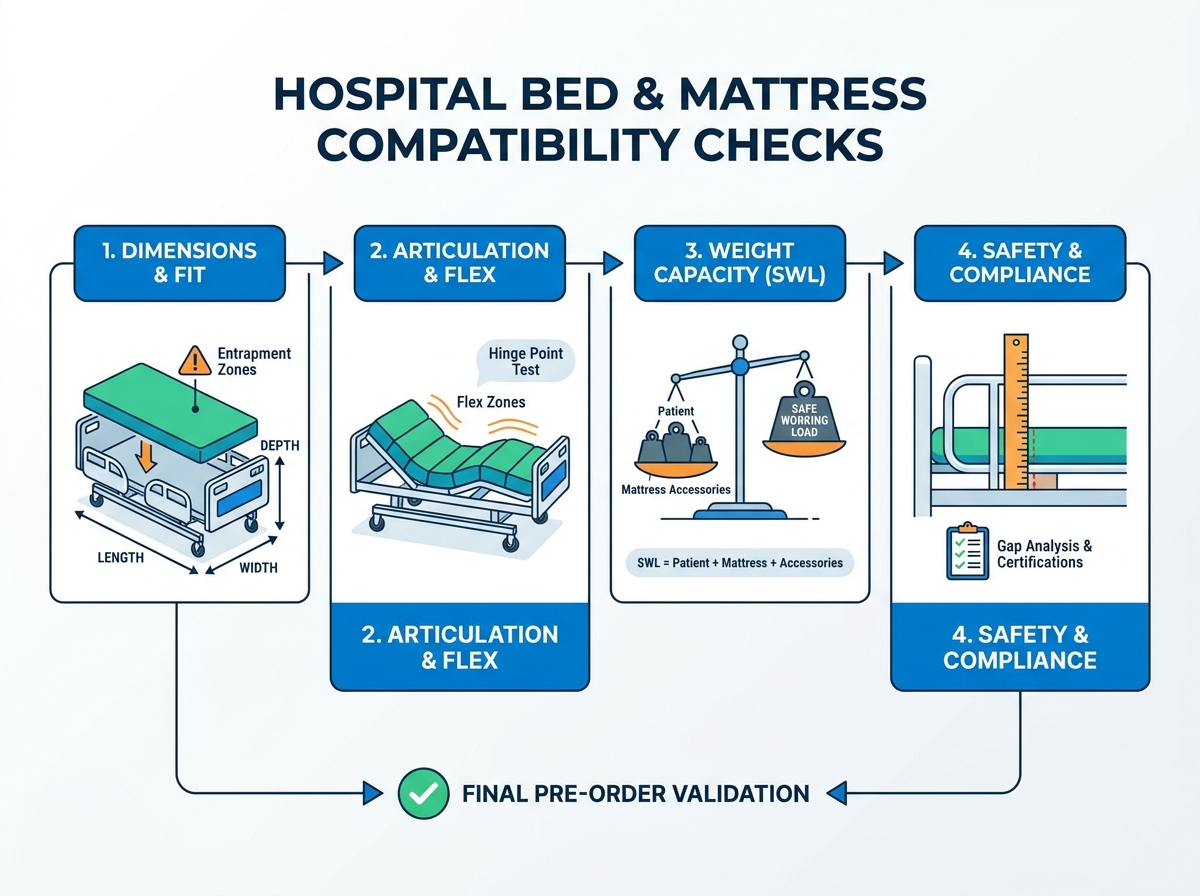
Step 2: Mechanical Articulation and Flexibility
The hinge point test matters greatly for daily operations. Foam must feature specific flex zones to work properly. Manufacturers use scored foam for better flexibility. It must bend smoothly alongside head and knee sections. This flexibility is absolutely critical for hospital beds. Without these V-cuts, the material resists the motor. This creates a trampoline effect at the patient's midsection.
Bottoming out occurs at sharp pivot points during elevation. Elevating the frame past 45 degrees stresses standard materials heavily. Standard foam compresses entirely under this centralized load. It exposes the patient directly to the hard metal decking. This causes immediate discomfort and rapid tissue damage. High-resilience core layers prevent this dangerous compression.
Advanced medical mattresses include alternating pressure functions. These automated systems require specific pump clearance. Standard profiling frames differ greatly from ICU-grade platforms. You must ensure adequate housing for pumps and bulky air hoses. Confirm proper cable management options on the frame. Verify CPR release compatibility for rapid deflation during emergencies.
Best Practices for Articulation Testing
Raise the head section to a full 90-degree angle.
Observe the crease for extreme material bulging.
Check the foot section for sliding or shifting.
Listen to the actuator motor for straining sounds.
Step 3: Weight Capacity and Safe Working Load (SWL)
Never rely on patient weight alone when evaluating limits. The industry-standard formula dictates safety capacities strictly. Safe Working Load equals patient weight plus mattress weight plus accessories. This combined total dictates your true operational load. Heavy air-fluidized systems add significant weight to the frame. You must calculate this before finalizing any order.
Dynamic loads differ completely from static resting weight. Articulating the frame shifts weight distribution rapidly across the deck. This transfer burdens different frame sections heavily. Motors must handle these peak stresses seamlessly during elevation. A frame might hold 400 pounds statically but fail dynamically. Always check the dynamic lift capacity specifically.
Bariatric shortlisting requires careful mathematical alignment. When buying a heavy-duty hospital bed with mattress, density matters. The Indentation Load Deflection (ILD) indicates overall foam firmness. This ILD must mathematically align with motor capacities. Too dense, and the motor struggles to lift the assembly. Too soft, and you risk bottoming out.
Step 4: Mitigating Entrapment Risks (Safety & Compliance)
Regulatory bodies outline seven distinct zones of entrapment. These danger zones form between moving structural parts. Gaps appear between the pad, bed deck, and side rails. They pose severe asphyxiation risks for vulnerable individuals. Evaluating these zones is mandatory in professional care settings. Small limbs can easily slip into poorly fitted gaps.
Compression under load complicates visual inspections significantly. A setup might look perfect when completely empty. However, foam compresses heavily under resting patient weight. This creates sudden, hazardous gaps during daily use. Edge support becomes a critical factor here. Firm perimeter borders prevent sideways compression near the rails.
We strongly recommend ordering certified systems directly from manufacturers. Look for documented OEM-tested compatibility certificates. Certifications prove rail-and-mattress combinations meet strict safety standards. They provide essential peace of mind for buyers. Avoid mixing random brands without verifying these exact tolerances.
Entrapment Zone Risk Chart
| Zone Designation | Location Description | Primary Mitigation Tactic |
Zone 1 | Within the side rail itself | Use updated, narrowly spaced rails |
Zone 2 | Under the bottom of the side rail | Ensure adequate mattress thickness |
Zone 3 | Between rail and mattress edge | Use firm perimeter edge foam |
Zone 4 | Under the rail at the deck ends | Align rail positioning perfectly |
Step 5: The Final Pre-Order Checklist
Review the entire accessory ecosystem closely before buying. Check compatibility for fitted sheets and absorbent underpads. Standard bedding pops off articulating surfaces easily during elevation. You need deep-pocket sheets for reliable, everyday use. Thick overlays also change your total rail clearance height. Factor every single layer into your final safety math.
Discuss vendor guarantees before signing any purchase orders. Ask suppliers about their specific return policies. You need clear terms for mismatched components. Restocking fees for large medical equipment run extremely high. Transparent vendors will guarantee compatibility if you provide exact measurements. Get this guarantee in writing beforehand.
Follow these actionable next steps to finalize your decision:
Measure the specific sleep deck inside the retainers.
Confirm the articulation angles of the bed motor.
Match the mattress flex points and weight ratings.
Verify side rail height clearances under compression.
Check pump bracket sizing for alternating pressure systems.
Calculate the exact Safe Working Load.
Conclusion
Verifying compatibility upfront prevents costly returns and supply chain headaches. Proper pairing safeguards patient health proactively against pressure injuries. It also eliminates dangerous entrapment zones near the rails. Prioritize vendors offering transparent dimensions and technical specifications. Rely on dedicated customer support to validate your pairings beforehand. Taking these steps ensures a safe, functional environment for every patient.
FAQ
Q: Can I use a regular memory foam mattress on a hospital bed?
A: No. Standard memory foam lacks the specific flex points required for articulation. It typically voids bed motor warranties due to stiffness. Standard foam also fails to meet clinical pressure redistribution needs for patients.
Q: How thick should a mattress be for a standard hospital bed?
A: It should typically measure 6 to 7 inches thick. This maintains a safe height ratio regarding standard side rails. Proper thickness effectively mitigates fall risks and dangerous entrapment hazards.
Q: What happens if a medical mattress is too light for an alternating pressure bed frame?
A: Too little weight causes sensor errors in automated systems. The pad risks shifting out of place during mechanical articulation. You must secure it properly using corner straps or heavy-duty bolsters.
Q: Do hospital beds require special sheets?
A: Yes. The constant mechanical movement requires deeper pockets. You need high-stretch knits to prevent corners from popping off. Standard sheets will not stay secured during head and foot elevation.

Get our 2026 Product Catalogue & Book a VIP Meeting
Leave your contact information and our online customer service will contact you shortly.
Reserve a 15-min VIP Consultation with our Engineering Lead. The number of places is limited.
