

 English


Specifying medical stretchers goes far beyond basic patient conveyance. It serves as a vital component of modern clinical transport operations. Proper selection directly impacts staff injury rates. It ensures patient transfer safety and improves daily workflow efficiency. Yet, buyers often face significant procurement friction when evaluating these assets. Generic or poorly matched specifications lead to frustrating facility bottlenecks. They cause increased maintenance downtime and ultimately compromise critical clinical interventions. When hospitals ignore precise technical criteria, they put both patients and caregivers at unnecessary risk. This article provides a rigorous evaluation framework for specific technical specifications. We focus heavily on height adjustability, advanced braking systems, and facility routing compatibility. You will learn how to assess these vital components effectively. We will guide you through matching equipment to strict architectural constraints. Our goal is to help you support evidence-based, highly practical procurement decisions.
Key Takeaways
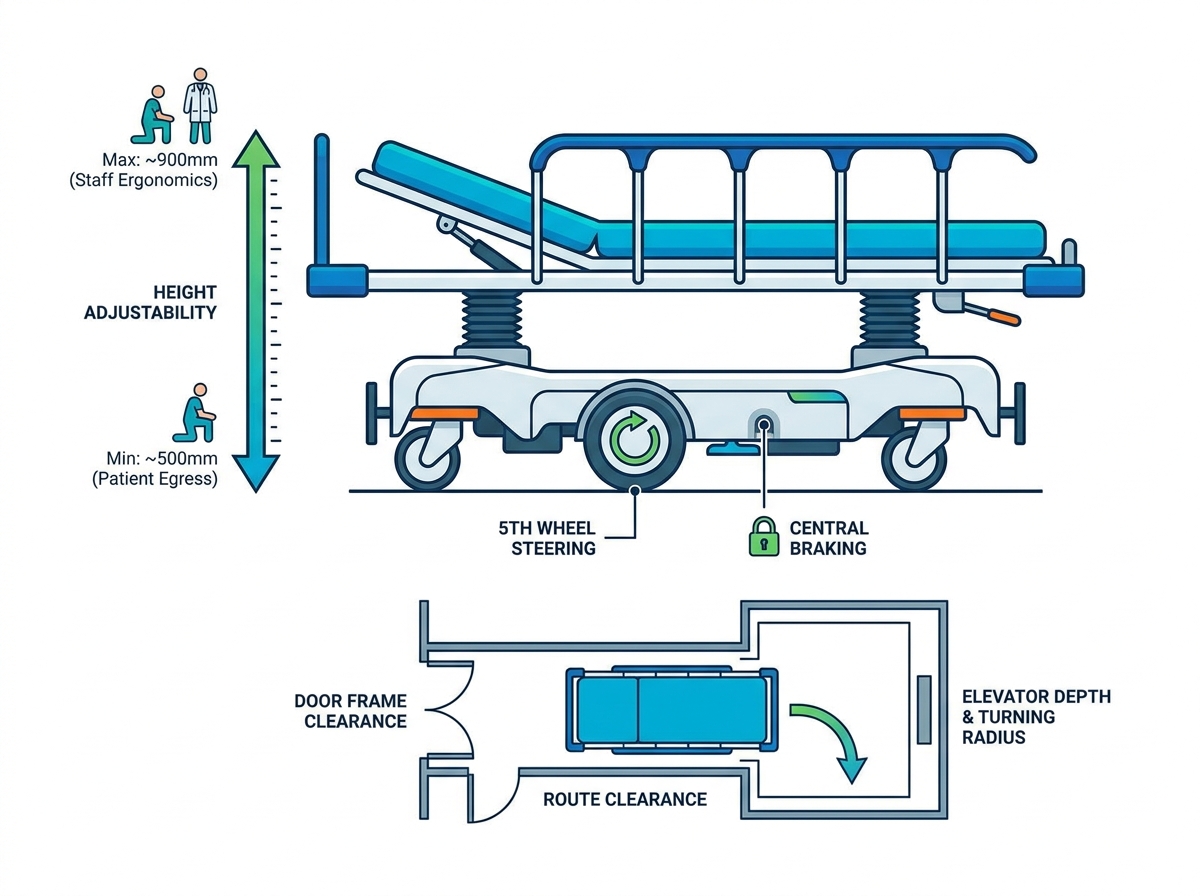
Ergonomics & Safety: A true height-adjustable stretcher mitigates staff musculoskeletal strain during lateral patient transfers, requiring a dynamic range of approximately 500mm to 900mm.
Mobility Control: Centralized braking and 5th-wheel steering systems are non-negotiable for high-traffic emergency and transport scenarios to prevent drift and reduce turning radius.
Architectural Alignment: Route clearance must account for elevator depth, door frame widths, and corridor cornering angles prior to fleet procurement.
The Role of Height-Adjustable Stretchers in Clinical Ergonomics
Lateral patient transfers require precise bed heights. Clinical interventions like CPR or intubation also demand optimal positioning. Fixed or limited-range beds severely increase staff injury risks. They force nurses to adopt poor postures during critical moments. This complicates safe patient egress and routine transfers. Musculoskeletal strain remains a leading cause of caregiver burnout. You can mitigate this risk through proper equipment selection.
You need specific benchmarks when evaluating a height-adjustable stretcher. Look for an ideal high-low dynamic range. The bed should drop to a minimum of approximately 500mm. This exceptionally low height ensures safe patient ingress and egress. It closely matches standard wheelchair heights. It also minimizes fall risks for disoriented patients. The bed should elevate to a maximum of approximately 900mm. This higher elevation supports clinical staff ergonomics. It brings the patient directly to waist level for typical clinical procedures.
Next, compare the primary actuation mechanisms to understand their operational impacts.
Dual-pedal hydraulic systems serve as the reliable standard. They remain fully operational during power outages. They require no electronic troubleshooting.
Electric columns provide smoother, automated height transitions. They reduce physical pumping efforts for staff. However, they demand strict battery management protocols. You must ensure they remain fully charged.
Finally, evaluate the load behavior under active articulation. You must verify the Safe Working Load (SWL). The equipment must remain entirely stable across the full height spectrum. Watch closely for chassis deflection. If the frame bows at maximum elevation, it compromises safety.
Best Practice: Always test the stretcher articulation at maximum SWL. This helps identify hidden chassis weaknesses before purchase.
Common Mistake: Ignoring the low-height benchmark. A bed stopping at 600mm remains too high for safe independent patient egress.
Evaluating Braking Systems on a Patient Transport Trolley
A moving patient transport trolley carries significant physical momentum. Control and stability realities dictate emergency department workflows. A fully loaded unit can weigh well over 300kg. Stopping distance matters immensely in crowded hospital hallways. Stationary stability proves critical for surgical holds and triage areas. You cannot compromise on these safety features.
Individual caster locks fail repeatedly in real-world clinical evaluations. They take too long to engage during emergencies. Staff must physically walk around the bed to lock each wheel. They also succumb easily to mechanical wear. You require robust 4-wheel central locking systems instead. Staff must access these locks from multiple intuitive points. Head and foot end controls ensure immediate immobilization during crises. One simple pedal press should lock all four wheels simultaneously.
Directional tracking heavily relies on modern 5th wheel technology. Assess the inclusion of a retractable center track wheel. This central component drastically reduces physical steering effort. It prevents the trolley from drifting laterally on sloped floors. It allows you to pivot the equipment precisely on its own axis. This high maneuverability shines in confined clinical spaces and crowded wards.
Consider brake material construction and ongoing maintenance requirements. Look for fully enclosed braking components. Exposed parts invite dust and debris accumulation. Fluid ingress degrades braking efficacy over time. Enclosed systems protect the internal mechanisms from harsh cleaning chemicals.
Best Practice: Engage the central brake and physically push the trolley from the side. It should resist lateral movement entirely.
Common Mistake: Ignoring caster housing materials. Open housings collect floor wax and bio-fluids, rapidly destroying brake friction pads.
Route Clearance: Matching Hospital Stretchers to Facility Architecture
A comprehensive facility compatibility audit prevents disastrous procurement errors. Buying advanced hospital stretchers is useless if they bottleneck at elevator banks. They must pass seamlessly through intensive care unit doorways. You must map your building pathways before you buy.
Dimensional evaluation criteria demand strict attention. Compare the overall equipment width against your standard door frames. You must include deployed side rails and exterior bumpers in this measurement. Standard units typically require door clearances under 850mm. Bariatric models introduce complex architectural exceptions. They require dedicated route mapping protocols. Their wider frames frequently exceed 900mm. You cannot force them safely through older facility doors.
Turning radius constraints also dictate building compatibility. Map the wheelbase dimensions accurately. Compare the steering mechanisms against right-angle corridor turns. Tight elevator entries often expose poor equipment maneuverability. A long wheelbase provides straight-line stability but requires wider turning arcs.
Finally, account for essential accessory clearance. You must calculate vertical and horizontal operational envelopes carefully. Factor in extended IV pole heights. Include oxygen tank holders and protruding monitor trays. These accessories often catch on door frames or low elevator ceilings.
Facility Clearance Evaluation Guide
| Evaluation Zone | Standard Requirement | Bariatric Challenge | Actionable Check |
Patient Room Doors | > 850mm clearance | Requires > 1000mm clearance | Measure width with side rails fully deployed. |
Elevator Depth | Accommodates 2200mm length | May require specialized service elevators | Account for IV poles and headboard accessories. |
Corridor Corners | Standard 90-degree pivot | Requires wider sweep radius | Test 5th-wheel engagement on actual tight corners. |
Secondary Specifications That Influence Procurement
Side rail functionality impacts patient safety daily. They must provide absolute zero-gap compliance. This prevents dangerous patient entrapment incidents. Evaluate the specific drop mechanism carefully. Compare tuck-away designs against standard fold-down versions. Tuck-away rails typically offer superior zero-transfer-gap compatibility. They slide neatly under the main mattress deck. This allows beds to sit entirely flush against surgical tables.
Mattress integration dictates clinical comfort and overall care quality. The trolley must balance effective pressure redistribution. Extended patient holds in emergency departments require soft, supportive surfaces. This prevents painful pressure ulcers from forming. However, the surface must retain enough underlying firmness. High firmness ensures CPR efficacy during sudden cardiac events. Too much foam dangerously absorbs chest compressions.
Radiolucency and C-arm access matter greatly for active trauma units. Assess the required percentage of radiolucent surface area. Adequate x-ray transparency avoids unnecessary patient transfers. Staff can perform imaging directly on the transport surface. They do not need to move fragile patients to dedicated imaging tables. Look for full-length radiolucent decks in specialized emergency models.
Consider the placement of integrated push handles. Ergonomic handles reduce wrist strain during long clinical transports. They should safely accommodate caregivers of varying heights. Evaluate the oxygen tank holders carefully. They must secure heavy cylinders firmly during transit. Loose tanks pose severe safety hazards. Integrated IV poles must offer rapid single-handed adjustments. This allows nurses to manage fluids while steering simultaneously.
Implementation Risks and Procurement Next Steps
Fleet standardization heavily mitigates operational implementation risks. Mixing different models across a facility increases the staff training burden. Nurses struggle to find the right brake pedals during emergencies. It severely complicates spare parts inventory management. Assess the viability of standardizing on a single modular chassis design. This simplifies both clinical training and routine maintenance.
Maintenance realities require proactive facility planning. Evaluate the vendor’s Service Level Agreement thoroughly. Prioritize models featuring open-architecture hydraulics. Accessible casters enable rapid in-house biomedical engineering repairs. This keeps equipment downtime to an absolute minimum. You should not wait weeks for proprietary manufacturer parts.
Biomedical engineers need clear access to internal hydraulic pumps. Complex, enclosed chassis designs frustrate maintenance teams. They turn simple seal replacements into hours of intensive labor. Request the service manual before finalizing any purchase. Review the troubleshooting steps for common mechanical failures. Standardized caster designs allow you to keep fewer spare parts on the shelf.
Follow a clear, structured shortlisting logic:
Audit all critical facility dimensions, including doors and elevators.
Define the exact clinical use-case, distinguishing between trauma and general transport.
Request on-site vendor demonstrations immediately.
Target lateral transfers and corridor maneuverability during these demos.
Involve frontline nursing staff heavily in the physical testing phase.
Common Mistake: Relying purely on brochure dimensions. Always measure the physical unit with all standard accessories attached.
Conclusion
Technical specifications profoundly impact clinical outcomes. Core features like height range and braking control directly tie to facility risk management. Ignoring these parameters jeopardizes both patient safety and staff well-being. Proper equipment reduces musculoskeletal injuries and streamlines emergency workflows.
We recommend basing your final shortlisting on verifiable technical data. Prioritize architectural compatibility above basic aesthetic preferences. Do not ignore your building's physical limitations. Evidence-based evaluation ensures your equipment actually performs securely under high-stress conditions.
Take decisive action before your next purchasing cycle. Encourage your procurement teams to request detailed technical specification sheets. Arrange a comprehensive, multi-departmental hands-on trial to validate real-world performance. Involve your frontline caregivers early in the evaluation process.
FAQ
Q: What is the standard weight capacity (SWL) for a hospital stretcher?
A: Standard models typically support 220kg to 250kg (500-550 lbs). Specialized bariatric models are engineered for much heavier loads. They comfortably handle 315kg to over 450kg (700-1000 lbs). Always verify the stated capacity against actual patient demographic needs in your specific medical facility.
Q: Why is a 5th wheel necessary on a patient transport trolley?
A: It acts as a highly effective central pivot point. This specialized wheel significantly reduces the physical push force required by clinical staff. It allows for sharper, highly controlled turns. You will find it essential when navigating crowded hospital corridors and tight facility corners.
Q: How do hydraulic and electric height-adjustable stretchers compare in maintenance?
A: Hydraulic stretchers rely on traditional fluid dynamics. They require periodic seal checks but operate independently of facility power. Electric stretchers offer precise control and smart data integration. However, they demand strict battery lifecycle management and specialized electronic component maintenance from biomedical teams.

Get our 2026 Product Catalogue & Book a VIP Meeting
Leave your contact information and our online customer service will contact you shortly.
Reserve a 15-min VIP Consultation with our Engineering Lead. The number of places is limited.
