

 English

Power mobility provides independence, but practical realities dictate that batteries deplete, electronic components fail, and tight indoor spaces frequently require manual positioning. Many buyers focus entirely on battery range, top speed, and motor power, completely overlooking the mechanical realities of pushing a heavy power chair. A poorly designed manual mode can leave users stranded in vulnerable situations or cause severe caregiver strain during emergency transport. Evaluating the freewheel mechanism is a non-negotiable step in the decision-stage journey. Buyers must look beyond the electronic specifications to understand how the chair functions when the power is cut. This guide provides a comprehensive framework for assessing lever accessibility, push resistance, safety protocols, and physical ergonomics before finalizing a purchase. You must verify these mechanical baselines to ensure the chosen device remains functional, manageable, and safe even without battery power.
Mechanism Accessibility: The placement of freewheel levers determines whether the user can independently disengage the motors or if caregiver assistance is strictly required.
Weight-to-Push Ratio: An electric wheelchair may have a manual mode, but a total weight exceeding 150 lbs makes it practically unpushable on inclines or thick carpets.
Braking Realities: Disengaging the motors disables the electromagnetic braking system; buyers must verify secondary braking options for caregiver control.
Ergonomic Alignment: Caregiver handle height, joystick clearance, and stride clearance are critical evaluation metrics for electric wheelchairs with manual mode intended for frequent assisted use.
Understanding the Mechanics of "Freewheel" Mode
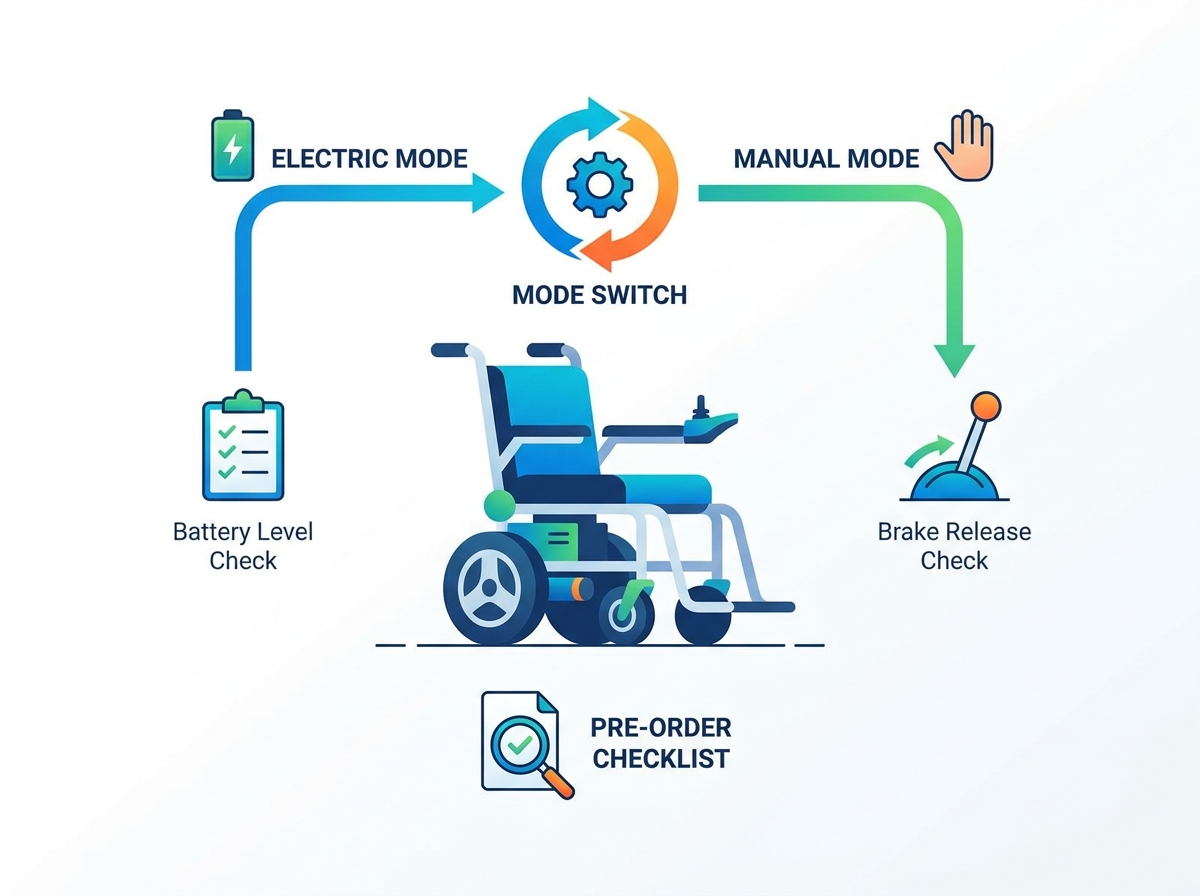
To properly evaluate a mobility device, buyers must first understand the mechanical process of disengaging the drive motors from the wheels. This process, commonly referred to as freewheeling, allows the wheels to spin freely without electrical or magnetic resistance. In standard operation, the motors are locked to the wheels, providing both propulsion and braking. When switched to manual mode, a physical clutch mechanism separates the gearbox from the wheel axle. This mechanical separation makes it physically possible to push the chair.
Most modern power chairs feature two independent motors driving the rear or center wheels. This dual-motor design requires the user or caregiver to disengage two separate clutches or levers to push the chair straight. If only one lever is disengaged, the chair will pivot uncontrollably around the locked wheel. Understanding this dual-lever requirement is necessary for safe operation, especially in stressful situations where a quick transition to manual pushing is required.
Realistic scenarios requiring manual mode extend far beyond a dead battery. Navigating ultra-tight thresholds in older homes often requires a caregiver to manually angle the chair. Emergency power loss during transit, loading the device into non-adapted vehicles, or making minor positioning adjustments at desks and dining tables are frequent occurrences. In these situations, turning the chair off and popping it into freewheel mode is often faster and safer than attempting micro-adjustments with a sensitive joystick.
Buyers must recognize the technical limitations of this feature. An electric wheelchair in manual mode does not function as efficiently as a dedicated ultra-lightweight manual wheelchair. The center of gravity is optimized for motor traction, not manual pushing. The added weight of the batteries, heavy-duty frame, and dormant motors creates significant drag. The freewheel mode is a vital fail-safe and positioning aid, but treating heavy power chairs as true dual-purpose manual devices is a mistake.
Power down the joystick controller completely to prevent electronic faults.
Locate the left and right freewheel levers near the drive wheels.
Firmly push or pull both levers into the designated "freewheel" or "unlocked" position.
Gently push the chair forward a few inches to confirm both gears have fully disengaged.
Core Evaluation Dimensions: Assessing the Manual Mode
Lever Placement, Grip, and User Independence
The physical location of the freewheel levers dictates the level of independence a user retains. Typically, these levers are located directly on the motors near the rear or center drive wheels. Buyers must evaluate the physical requirements for a seated user to reach and operate them. If the levers are tucked low behind the battery shroud, a user with limited trunk mobility will be entirely dependent on a caregiver to engage or disengage the motors. Some models feature top-mounted levers accessible from the seated position, which greatly enhances user autonomy.
Actuation force is another metric to test. Evaluate the grip strength and leverage required to flip the levers. Stiff, purely mechanical mechanisms can be a severe barrier for users with limited dexterity, arthritis, or reduced upper body strength. The levers should operate smoothly with a definitive click, providing tactile feedback that the clutch has fully disengaged or re-engaged.
Visual indicators are necessary for safety. Check for clear, high-contrast labeling indicating whether the chair is in "Drive" or "Push" mode. Accidental falls during transfers often occur because the chair was left in freewheel mode, causing it to roll away when the user applied weight to the armrests. Brightly colored levers or distinct positional changes help caregivers and users verify the chair's status at a glance.
Joystick Obstruction and Control Placement
The placement of the joystick heavily influences manual pushing and close-quarters transfers. Analyze how the control mount affects the overall width and profile of the chair. A non-clearable, rigidly mounted joystick can catch on clothing, doorframes, or walls when a caregiver is pushing the chair through tight spaces. Swing-away mounts are highly recommended, allowing the controller to be pushed aside, reducing the chair's footprint and protecting the sensitive electronics from impact.
Mechanical danger arises when the power state interferes with manual operation. Turning the power on while pushing in manual mode can cause severe issues. Many modern controllers will lock up, trigger heavy resistance, or throw error codes if they sense wheel movement while the joystick is active but the motors are disengaged. Always ensure the chair is completely powered down before engaging the freewheel levers to protect the controller board and gearbox.
Total Chair Weight vs. Push Resistance
The physics of pushing dictate that the base weight of the chair plus the user's weight translates directly to rolling resistance. Pushing a 50-pound folding chair with a 150-pound user requires vastly different physical exertion than pushing a 250-pound complex rehab chair with the same user. Buyers must calculate the total combined weight to understand the true physical demand placed on the caregiver.
Pushing a chair loaded near its maximum weight capacity exponentially increases rolling resistance. Under heavy loads, caster alignment becomes sluggish, and tire pressure becomes a major factor. Solid tires may resist deformation better under heavy loads, but pneumatic tires must be kept at optimal pressure; otherwise, the chair will feel like it is moving through wet sand when in manual mode.
Terrain acts as a massive multiplier for push resistance. Performance degrades rapidly on specific surfaces. High-pile carpet, thick grass, and uneven pavement create immense drag compared to smooth clinical floors or hardwood. Electric wheelchairs with manual mode must be tested on the surfaces they will encounter daily. What feels manageable in a showroom may become impossible to push across a thick living room rug.
Threshold testing is a practical necessity. Establish criteria for testing how easily the chair can be manually popped over a standard doorway threshold. This requires the caregiver to apply downward pressure on the rear of the chair to lift the front casters. If the chair lacks anti-tip wheel clearance or a dedicated step-tube, navigating thresholds in manual mode becomes a jarring and physically demanding task.
| Terrain Type | Rolling Resistance Level | Caregiver Effort Required | Caster Maneuverability |
|---|---|---|---|
| Smooth Indoor Flooring (Tile/Hardwood) | Low | Minimal | Excellent |
| Low-Pile Commercial Carpet | Moderate | Moderate | Good |
| High-Pile Residential Carpet | High | Significant | Poor (Casters may drag) |
| Outdoor Pavement / Concrete | Moderate to High | Moderate (Varies by incline) | Good |
| Grass / Gravel | Very High | Severe | Very Poor (Risk of sinking) |
Caregiver Ergonomics and Handling
The physical well-being of the caregiver is often overlooked until an emergency push is required. Evaluate the presence, height, and adjustability of rear push handles. Many power chairs lack ergonomic handles entirely, forcing caregivers to push awkwardly against the backrest or headrest. This poor ergonomic alignment leads to immediate shoulder and lower back strain. Chairs intended for frequent manual assistance must feature dedicated, comfortable grips positioned at an appropriate height.
Stride clearance is another vital ergonomic factor. Analyze the rear profile of the chair from the ground up. Caregivers need sufficient space to walk naturally behind the chair without kicking the anti-tip wheels, motor housings, or battery boxes. A chair that forces the caregiver to adopt a shortened, awkward stride will cause fatigue rapidly, making long-distance manual pushing unsafe and impractical.
Safety Risks and Mitigation in Manual Mode
The Loss of Electromagnetic Braking
Putting a power chair into manual mode inherently bypasses the automatic electromagnetic brakes. In normal drive mode, releasing the joystick cuts power to the electromagnets, which instantly clamp down on the motor shafts, stopping the chair. When the freewheel levers are engaged, this connection is physically severed. The chair will roll freely, relying entirely on the caregiver's physical strength to stop its momentum.
This creates severe runaway risks. Disengaging motors on an incline or decline is highly dangerous. If a caregiver loses their grip on a heavy power chair on a ramp, the chair will accelerate rapidly, posing a catastrophic risk to the user and bystanders. Manual mode should only be engaged on flat, level surfaces unless absolutely necessary and managed by multiple capable individuals.
Buyers must verify secondary braking solutions. Manual attendant brakes, similar to bicycle handbrakes mounted on the push handles, or traditional manual wheel locks are rare on heavy power chairs but necessary for safety. If the chair lacks secondary brakes, the caregiver must be acutely aware of their physical limits and the environmental topography before touching the freewheel levers.
Re-engagement Failures
The "half-engaged" hazard is a common mechanical failure point. This occurs when the freewheel levers are pushed back into the drive position but fail to lock fully into the gearbox splines. When the user attempts to drive, one motor may engage while the other slips, causing the chair to pivot unpredictably. Worse, the electromagnetic brakes may fail to hold the chair when the joystick is released. Caregivers must gently rock the chair back and forth after re-engaging the levers to ensure the gears are fully seated and locked.
Diagnostic errors frequently accompany manual mode usage. Most modern power chairs will throw a specific joystick error code (often a series of flashing lights or a screen warning) if powered on while in manual mode. Buyers should verify how intuitive it is to clear this error. Usually, it requires powering the chair down, ensuring the levers are locked in drive, and powering back up. Understanding this reset sequence prevents panic when the chair refuses to move after being pushed.
Conceptual Trade-Offs: Portability vs. Manual Usability
Folding/Travel Power Chairs
Folding and travel-oriented power chairs offer distinct advantages for manual usability. Their lighter overall weight, often ranging between 40 and 60 lbs, makes them significantly easier to push in manual mode. Caregivers can navigate tight spaces and minor inclines with much less physical strain. The reduced mass means the runaway risk on slight grades is lower, though still present.
These lighter frames come with compromises. Smaller caster wheels, optimized for portability, can flutter or catch in manual mode on outdoor terrain. Ultra-lightweight frames may lack dedicated, comfortable push handles, requiring caregivers to grip the backrest canes directly. The lack of suspension also means every bump is transferred to the user and the caregiver's hands during a manual push.
Heavy-Duty and Complex Rehab Chairs
Heavy-duty and complex rehab chairs prioritize stability and user positioning over portability. They often feature robust suspension systems which absorb shocks effectively, even if being pushed over rough terrain. The heavy base provides a low center of gravity, making the chair exceptionally stable and resistant to tipping during transfers or sudden movements.
The drawback is the extreme base weight, which can easily exceed 250 lbs before the user even sits down. Pushing these chairs in manual mode is strictly an emergency procedure, not a daily convenience. Seating configuration limits apply. Tilt, recline, and elevating leg rest functions are usually disabled or locked out when the chair is switched to manual mode, which can severely impact user comfort and medical positioning during prolonged manual pushes.
The Pre-Purchase Checklist: Testing the Manual Mode
Do not finalize a purchase without conducting a rigorous physical test of the manual mode. Theoretical specifications do not translate to real-world usability. Use the following checklist during the showroom visit or in-home trial to ensure the freewheel mechanism meets your practical needs.
The Dead-Battery Simulation: Request a test drive where the chair is completely powered down. Disengage the motors and attempt to maneuver the chair in a confined space to simulate a real-world electronic failure.
The Caregiver Test: Require the primary caregiver to push the occupied chair for at least 50 feet. This route must include at least one sharp turn and one threshold crossing to evaluate push resistance and ergonomic comfort.
The Transfer Test: Verify that the chair remains completely immobilized with the motors engaged during lateral transfers. Check how easily the levers can be switched to manual mode immediately after the user is seated.
The Joystick Clearance Check: Verify that the joystick controller can swing away completely. This prevents damage during manual positioning at tables, desks, or when passing through narrow doorways.
The Re-engagement Verification: Practice switching from manual back to drive mode. Rock the chair to ensure the gears lock, power on the joystick, and verify that no error codes persist.
Manual mode serves as a fail-safe in power mobility, ensuring users are not stranded during battery depletion or mechanical faults. Its practical utility depends entirely on the chair's total weight, the placement of the freewheel levers, and the primary caregiver's physical capacity. Ignoring these mechanical realities during the purchasing phase often leads to unsafe transfer situations and severe caregiver fatigue.
When shortlisting models, prioritize lightweight folding designs if you anticipate frequent manual pushing, vehicle loading, or navigating exceptionally tight indoor environments. Reserve heavy-duty and complex rehab models for users who will rely almost exclusively on power, treating the manual mode strictly as an emergency backup rather than a daily feature.
Take the following steps to finalize your evaluation:
Consult with an Assistive Technology Professional (ATP) or occupational therapist to map out your specific environmental barriers.
Schedule an in-person demonstration to physically test the freewheel mechanisms of your shortlisted models.
Measure the stride clearance and push handle height to ensure they match the primary caregiver's physical requirements.
Verify the exact weight of the fully assembled chair to calculate the true push resistance.
FAQ
Q: Can you push an electric wheelchair if the battery dies?
A: Yes, you can push the chair by locating and flipping the freewheel levers, which disengage the drive motors from the wheels. The physical effort required depends heavily on the chair's total weight and the terrain. Heavy-duty models require significant caregiver strength to push safely.
Q: Does pushing an electric wheelchair damage the motors?
A: Pushing is safe only if the motors are properly disengaged via the freewheel levers. Attempting to force the chair to roll while it is in drive mode with the motors engaged will cause severe damage to the gearbox and the electromagnetic braking system.
Q: How do you put a power wheelchair into manual mode?
A: First, turn off the power at the joystick to protect the electronics. Locate the freewheel levers, typically found on the motors near the rear or center wheels. Flip or rotate both levers to the unlocked position to disengage the gears.
Q: Why is my electric wheelchair resisting being pushed even when the power is turned off?
A: Electromagnetic brakes default to a locked state when the power is turned off. This is a safety feature to prevent the chair from rolling away. You must physically disengage these brakes using the manual freewheel levers to allow the wheels to spin freely.
Q: Why is my electric wheelchair beeping when I turn it on?
A: This is a common safety alert indicating that the chair is still in freewheel mode. The controller senses that the motors are disengaged. To fix this, turn off the joystick, re-engage the freewheel levers to the drive position, and turn the power back on.
Q: Are there electric wheelchairs with manual mode that work like standard wheelchairs?
A: Standard power chairs with a freewheel release are too heavy to be self-propelled efficiently. If you want a chair that works like a standard manual wheelchair, look into power-assist devices attached to ultra-lightweight manual frames, rather than traditional power chairs.
Q: Can the user reach the manual freewheel levers independently?
A: This varies significantly by model and the user's trunk mobility. Some chairs have top-mounted levers accessible from the seat, while others have levers tucked low near the floor, requiring a caregiver to reach them. Always test this reachability before purchasing.

Get our 2026 Product Catalogue & Book a VIP Meeting
Leave your contact information and our online customer service will contact you shortly.
Reserve a 15-min VIP Consultation with our Engineering Lead. The number of places is limited.
