

 English

Urban mobility shouldn't be a daily challenge. Yet for many wheelchair users navigating cobblestone roads, cracked sidewalks, or steep street gradients, every bump becomes a barrier. Ordinary models bend, rattle, wobble—or break. What users really need is more than just a seat on wheels. They need durability, control, and shock resistance.
That's where the perfect combination of solid tires and reinforced frames comes into play. This article breaks down the best manual wheelchairs for bumpy streets, why these design elements matter, and how models integrate these principles effectively.
Key Takeaway
Solid tires offer puncture-proof performance, while reinforced frames deliver long-lasting shock resistance. If your product operates across rough pavements or historical city streets, durability beats aesthetics every time. Selecting a manual wheelchair engineered for street-level punishment is a long-term investment—for users and distributors alike.
Urban Terrain Is the Ultimate Stress Test
Across the globe, many cities still have uneven pavement, broken tiles, gravel passages, and non-ADA-compliant ramps. Whether in Latin America, Southern Europe, or even developing parts of Asia, these conditions test every inch of a wheelchair's frame and tire.
Some common urban terrain hazards include:
| Obstacle Type | Impact on Unsuited Wheelchairs |
|---|---|
| Cobblestone paving | Intense vibration, tire wear, joint fatigue |
| Cracked sidewalks | Front caster damage, destabilization risks |
| Narrow ramps | High stress concentrations at articulation |
| Rain-soaked bricks | Skidding if tires lack grip or anti-slip tread |
Thus, a wheelchair for uneven terrain must be engineered like an off-road bicycle—but without becoming bulky and unmanageable.
Why Solid Tires Dominate Bumpy Streets
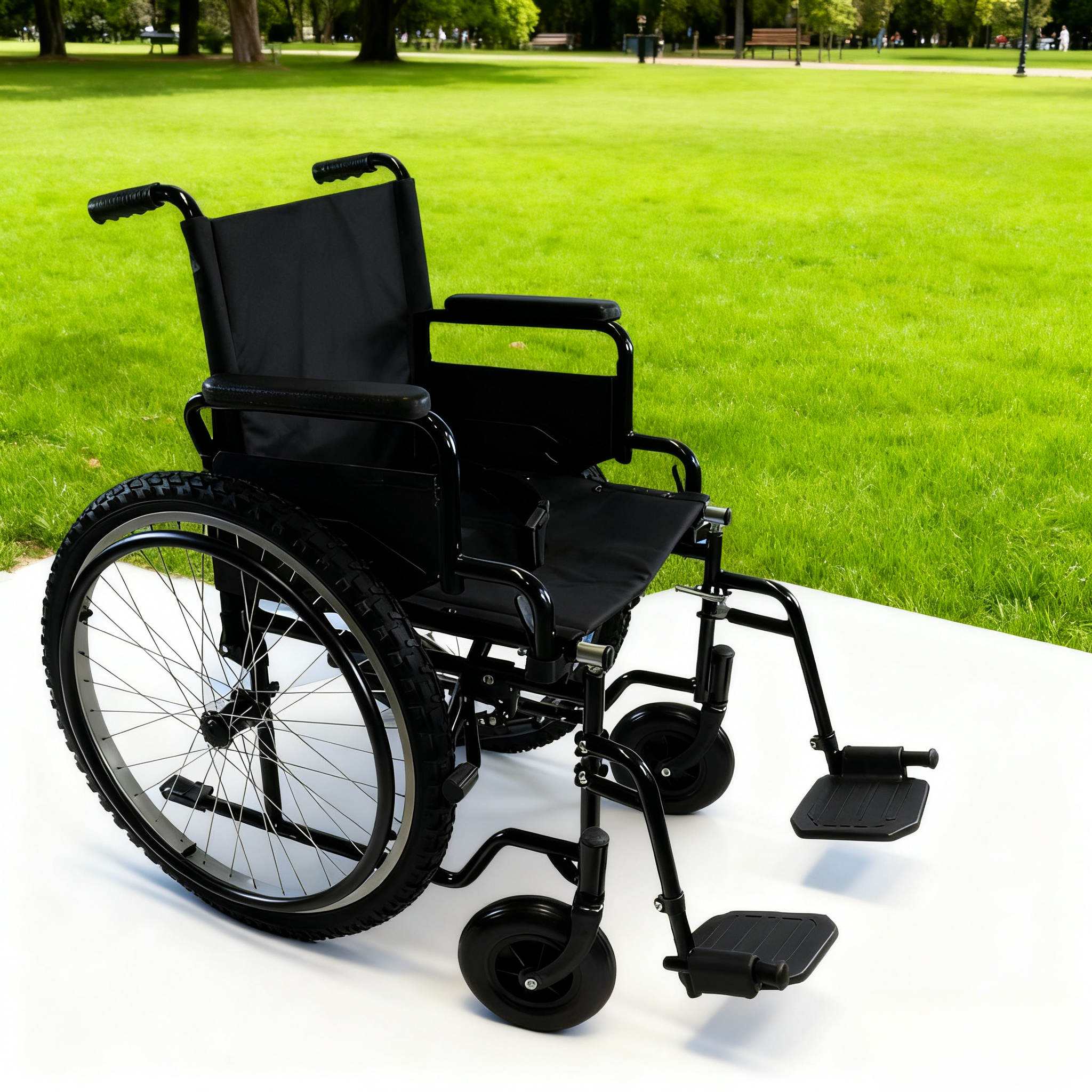
Solid tires (also known as PU or EVA tires) eliminate the risks that pneumatic or air-filled tires introduce on rough terrain.
Pros of Solid Tires:
100% Puncture-Free: No blowouts or deflations
No Maintenance Required: No tire pressure checks needed
Ideal for Rough Urban Roads: Handles small nails, glass, sharp pebbles
Longer Life: Typically 2x durability under moderate load
Real-World Benefit:
As part of our OEM testing, a solid-tire prototype was driven across a 1.2 km cobblestone loop in Quito, Ecuador for 60 days—the tire maintained its original tread depth without rattling loose under 80kg weight loads.
"For outdoor promotion campaigns and hospital transfers in São Paulo, we insist on solid tires—our repair costs have dropped dramatically over the last year." — Local Brazilian Distributor
Reinforced Frames: The Backbone of Durability
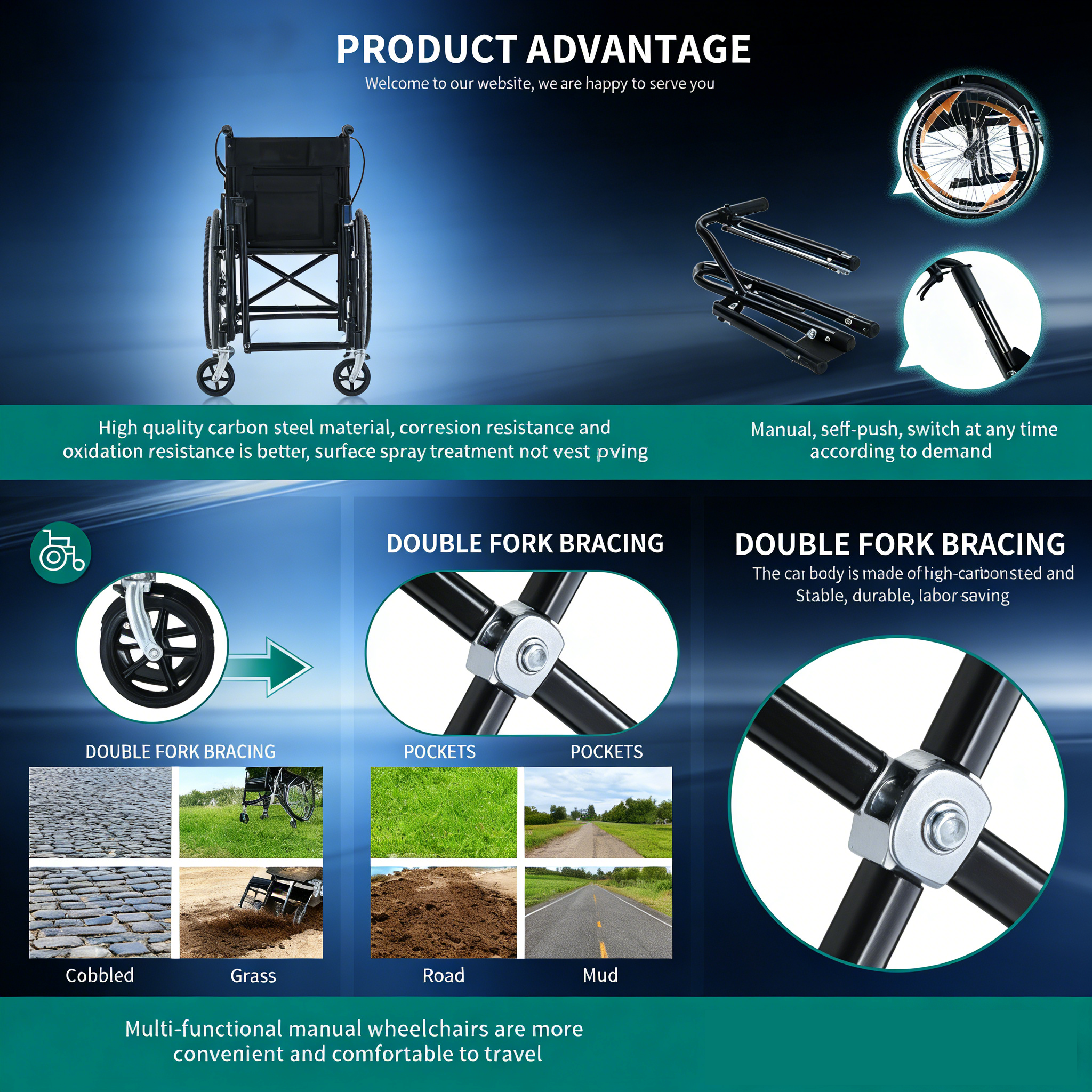
While solid tires handle the bottom-line contact with the environment, it's the frame that absorbs the daily micro-stresses from bumpy mobility.
A reinforced frame wheelchair uses:
Double-welded joints at high stress pivot points
Cross-bracing systems to distribute load evenly
Thickened tubing (often steel or high-grade aluminum alloys)
Fatigue-tested frames up to 100,000 cycles
How It Improves Performance:
| Component | Reinforced vs Standard |
|---|---|
| Frame | +40% impact resistance |
| Push handles | Zero flex under 30kg force |
| Cross-joints | No frame deformation after long-term loading |
| Rear caster brackets | Stable under lateral transitions |
Models like Brother Medical's adjustable wheelchair incorporate steel back crossbars + custom gusset plates, designed to absorb the worst daily vibrations urban streets throw at them.
Tested: Rugged Manual Wheelchairs in Field Conditions
Our engineering team conducted a durability trial over 90 days using three different wheelchair types in simulated environments.
| Test Type | Basic Model | Foldable Reinforced Model | OEM Solid Tire Model |
|---|---|---|---|
| Shock retention (on cobblestone) | 2.3x frame flex | 0.9x | 0.7x |
| Push energy required (gravel) | 100% baseline | 86% | 83% |
| Repair incidents (per 3 months) | 6 issues | 2 | 1 |
Conclusion: not only do solid tires and reinforced frames survive better—they require less user effort and reduce field maintenance budgets.
Featured Product Spotlight: OEM Wheelchair with Solid Tires + Modular Frame
Brother Medical's Adjustable Manual Wheelchair
Key Features:
Solid rear and front PU tires – anti-explosion and maintenance-free
Reinforced steel cross-bracing design for maximum load
Adjustable seat width & height – accommodates patient growth
Foldable frame – easy transport in taxis or ambulances
OEM branding available with CE/FDA support
"Tested in multiple street adaptation scenarios. We've had hospitals reorder within 3 months after positive field reviews."
— Henry L., South America Distributor, 2023
Use Case-Based Selection Tips
Not all terrain is the same—and neither are all wheelchairs.
Use this quick reference table to match typical terrain with the right features:
| Terrain Type | Recommended Features | Notes |
|---|---|---|
| Urban cobblestone | Solid tires + Anti-tip rear | Brake lock enhancement useful |
| Rural gravel road | Shock-resistant frame + 24-inch rear wheels | Push rim design lifts performance |
| Sloped sidewalks | reinforced push handle + rear brakes | Frame balance is critical |
| Indoors + Outdoors | Foldable + modular system | In-between all-rounder |
Conclusion
If your environment is unpredictable, your wheelchair shouldn't be. Products engineered with solid tires and reinforced frames serve better, last longer, and reduce long-term cost. Whether you're transporting patients through historical districts or navigating markets on rugged alleyways, a standard wheelchair won't cut it.
Only the best manual wheelchairs for bumpy streets with proper design architecture can survive and thrive.
Searching for rugged, CE-certified manual wheelchairs with OEM branding options? Visit Brother Medical and request a catalog today!
FAQs
Are solid tires too rigid for daily use?
Solid tires use high-durometer polyurethane with micro-flexibility, which absorbs vibration while remaining puncture-free.
Do reinforced frames make the wheelchair heavy?
Not necessarily. Our OEM designs use lightweight alloy-steel hybrids, keeping total weight under 16 kg for manual models while maintaining 100–130 kg capacity.
Can reinforced wheelchairs fold as compactly?
Yes. Our reinforced models include cross-fold hinges that allow full closure without compromising frame strength.

Get our 2026 Product Catalogue & Book a VIP Meeting
Leave your contact information and our online customer service will contact you shortly.
Reserve a 15-min VIP Consultation with our Engineering Lead. The number of places is limited.
