

 English

Importing bulk medical mobility devices carries immense financial and liability risks. Receiving non-compliant or defective units can severely disrupt distribution channels and damage brand reputation. The core business problem lies in the notorious gap between factory-provided "golden samples" and actual mass-production quality. Once heavy freight clears international customs, returning defective units is logistically impossible and financially ruinous. Establishing clear quality, certification, and model specifications in the procurement contract prior to paying the manufacturer's deposit builds the necessary foundation for a successful transaction. The Pre-Shipment Inspection (PSI) serves as the definitive, non-negotiable gateway for releasing final payment. It ensures technical, functional, and regulatory compliance before the goods ever leave the factory floor. Implementing a rigorous inspection protocol is the only empirical method to validate bulk order quality before financial leverage is lost.
Define strict Acceptable Quality Limit (AQL) standards specifically tailored for Class I/II medical devices to quantify pass/fail thresholds.
Mandate dynamic functional testing—including electromagnetic brake engagement, joystick latency, and maximum incline load testing—rather than relying solely on visual checks.
Prevent "short counts" and wrong specification errors by incorporating exhaustive quantity reconciliation and SKU verification into the inspection protocol.
Verify all international shipping compliance documentation, particularly UN38.3 certifications for lithium-ion batteries, prior to container loading.
Utilize independent, third-party inspection agencies specialized in electromedical equipment to prevent manufacturer bias and sampling manipulation.
Why a Specialized Pre-Shipment Inspection is Critical for Electric Wheelchair Orders
A successful bulk import requires meeting strict criteria: zero critical defects, correct quantity verification, intact packaging, and seamless customs clearance. Achieving these criteria demands a specialized approach to inspection. General consumer goods inspections focus heavily on cosmetics, but electromedical devices require rigorous functional and safety validation. When you import an electric wheelchair, you are importing a regulated medical device. The inspection must reflect the severity of the product's end-use.
The regulatory and liability stakes are exceptionally high. Failing to meet FDA, CE, or local medical device regulations results in port seizures, heavy fines, and potential user injury liabilities. Customs authorities routinely flag mobility devices for documentation checks. If the physical product does not perfectly match the submitted compliance files, the entire container can be impounded. Furthermore, if a defective unit causes injury to a user, the importer often bears the primary legal responsibility. A specialized PSI acts as a critical firewall against these catastrophic outcomes.
Importers frequently fall victim to the "golden sample" fallacy. Manufacturers produce a flawless pre-production prototype to secure the order. However, mass production involves different assembly lines, substituted components, and rushed labor. The final production run rarely matches the golden sample without strict oversight. Formal sample sign-off must link directly to the PSI criteria. The inspector must have the signed-off sample on hand to compare material thickness, motor specifications, and finish quality against the mass-produced batch.
Receiving incorrect configurations or missing accessories once goods have cleared international customs creates massive financial losses. The cost of "wrong specs" and "short counts" extends beyond the missing items. It delays fulfillment, violates distributor agreements, and requires expensive local sourcing of replacement parts. A specialized PSI verifies every SKU, color variant, and accessory box before the container is sealed, ensuring you receive exactly what you ordered.
Establishing AQL (Acceptable Quality Limit) for Mobility Devices
Applying standard AQL tables, such as ISO 2859-1, to mobility device bulk orders requires specific customization. You cannot use the same defect thresholds for medical equipment as you would for apparel or simple electronics. The evaluation dimensions must prioritize user safety and mechanical reliability above all else. The AQL determines the statistical sample size drawn from the bulk order and sets the maximum number of allowable defects before the entire batch fails the inspection.
| Defect Category | AQL Standard | Description & Examples | Action Required |
|---|---|---|---|
| Critical | 0.0 | Faulty electromagnetic brakes, exposed high-voltage wiring, battery thermal risks, missing regulatory safety labels. | Immediate batch failure. 100% factory rework and full re-inspection required. |
| Major | 1.0 - 1.5 | Misaligned folding mechanisms, abnormal motor noise, dead zones in joystick, incorrect accessory counts. | Factory must correct identified units. Batch may pass if total major defects remain below statistical threshold. |
| Minor | 2.5 - 4.0 | Minor paint scratches, slightly misaligned decals, minor upholstery wrinkles, small carton scuffs. | Monitor for quality control trends. Acceptable within statistical limits. |
Critical Defects (AQL 0.0) represent zero-tolerance issues. If an inspector finds even one critical defect in the sample size, the entire shipment fails immediately. For mobility devices, critical defects include faulty electromagnetic brakes, exposed high-voltage wiring, battery thermal risks, and missing regulatory safety labels. Any defect that could cause user injury, start a fire, or result in a customs seizure falls into this category. There is no negotiation on AQL 0.0 failures; the factory must rework or replace the affected units and submit to a full re-inspection.
Major Defects (AQL 1.0 - 1.5) encompass functional impairments that do not pose immediate safety risks but significantly affect usability and product lifespan. Examples include misaligned folding mechanisms that require excessive force to operate, abnormal motor noise indicating internal friction, dead zones in the joystick controller, or incorrect accessory counts within the individual cartons. While a small number of major defects might be statistically acceptable depending on the batch size, they require immediate factory correction for the specific units identified.
Minor Defects (AQL 2.5 - 4.0) identify cosmetic issues that do not impact the function or safety of the device. These include minor paint scratches on the frame, slightly misaligned brand decals, minor upholstery wrinkles, or small scuffs on the outer shipping carton. While minor defects are less severe, excessive cosmetic issues indicate poor factory quality control and should be monitored closely.
Establishing a strict defect logging protocol is essential. The third-party inspector must systematically record, photograph, and document every non-compliant item. The final inspection report must include high-resolution images of the defect, a clear description of the issue, and the exact quantity of affected units. This documentation provides the empirical evidence needed to demand factory rework or withhold final payment.
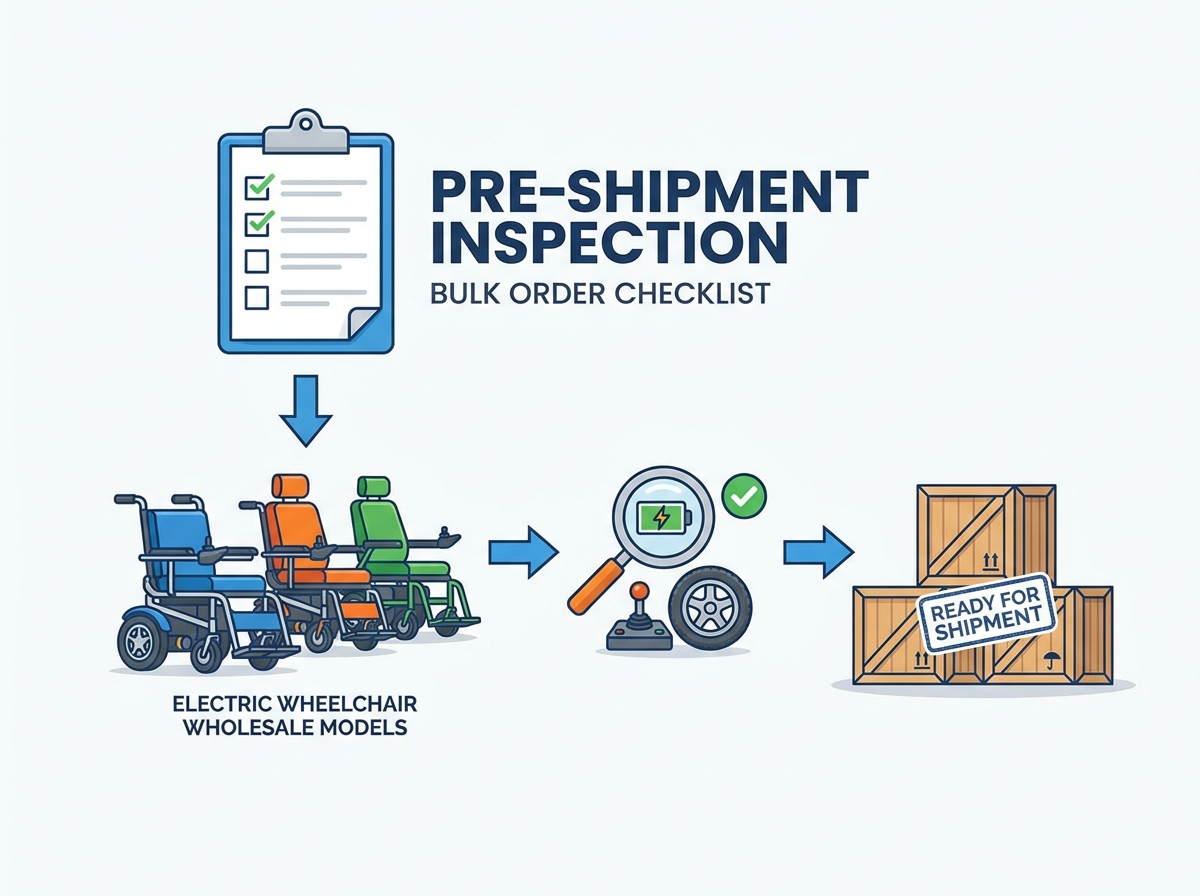
The Complete Electric Wheelchair Pre-Shipment Inspection Checklist
Structuring the core inspection into distinct, actionable phases ensures the on-site inspector covers every critical component. A comprehensive checklist prevents oversight and provides a standardized framework for evaluating the entire production batch.
1. Quantity, SKU, and Visual Integrity Checks
The inspection begins with exhaustive quantity reconciliation. The inspector must verify the total box count and individual unit counts against the purchase order to prevent short-shipping. This includes checking the breakdown of colors, sizes, and specific configurations. Once the quantities are confirmed, the inspector draws the random AQL sample for physical evaluation.
Count total master cartons against the packing list.
Verify SKU breakdown (colors, seat widths, battery options).
Draw the random AQL sample from different pallets and locations within the warehouse.
Visual integrity checks focus on the frame and welding. Inspectors must examine weld consistency, looking for cold welds, porosity, or sharp edges that could compromise structural joints. The anti-corrosion powder coating application must be uniform, without bubbling or flaking, ensuring the frame can withstand outdoor environments.
Folding and adjustment mechanisms require manual testing. The inspector must verify the smooth operation of folding frames, ensuring locking pins engage securely without excessive force. Adjustable armrests, elevating leg rests, and footplate locking mechanisms must hold their positions firmly under pressure. Upholstery and seating are checked for material durability, correct dimensions, and adherence to required fire-retardant standards.
2. Electrical Systems and Battery Verification
The electrical system is the most critical and expensive component of the device. Battery specifications must be verified against the purchase order exactly. The inspector checks the battery capacity (Ah), voltage (V), and chemistry (e.g., Lithium Iron Phosphate or standard Lithium-Ion) printed on the battery casing. They must also verify the physical dimensions and weight of the battery packs to ensure they match the approved golden sample.
Wiring and connectors require close visual inspection. Wire routing must be clean and secured with proper ties to ensure no pinch points exist during the folding process. Inspectors verify the secureness of all terminal connections, checking for proper insulation and the absence of exposed copper. Controller connections must be tight and free of debris.
Charger compatibility is a frequent point of failure in international orders. The inspector must test the included chargers for correct voltage input/output. They must physically verify that the charger plugs match the regional requirements of the destination country (e.g., US 110V vs. EU 220V plugs). Supplying the wrong charger renders the device useless upon arrival.
3. Dynamic Motor, Controller, and Drive Testing
Static visual checks are insufficient for motorized equipment. Dynamic testing is mandatory. Joystick calibration testing checks for responsiveness, the absence of dead zones, and accurate speed control mapping. The device should accelerate smoothly without jerking and track straight when the joystick is pushed directly forward.
Electromagnetic braking tests are critical for user safety. The inspector must conduct tests to ensure brakes engage immediately upon joystick release. This test is performed on flat surfaces and on specified inclines. The device must come to a complete stop within the required distance and hold its position on a slope without rolling backward.
Load and incline testing stress-tests the entire system. The inspector tests the unit with the maximum rated weight capacity (using sandbags or calibrated weights) on a standard incline, typically between 8 to 12 degrees. This verifies motor torque, battery discharge rates under load, and the functionality of the anti-tip wheels. The motors should not overheat, and the controller should not trigger thermal overload protection during this test.
4. Packaging, Labeling, and Transit Preparation
Proper packaging is the final defense against transit damage. Carton specifications must be verified, ensuring the use of multi-layer corrugated box thickness appropriate for heavy freight. Internal packaging must include custom foam molding to protect fragile components like joysticks and plastic shrouds. Moisture barriers, such as silica gel packets and plastic wrapping, must be present to prevent corrosion during ocean transit.
Mandating standard ISTA carton drop tests evaluates packaging resilience against rough freight handling. The inspector drops the fully loaded carton from specified heights onto its corners, edges, and flat faces. After the drops, the carton is opened to verify that the device inside remains undamaged and fully functional.
Labeling and barcode compliance ensure seamless warehouse receiving. All cartons must feature correct handling symbols (e.g., "Fragile," "Keep Dry," "This Way Up"). Barcodes must scan correctly and match the buyer's distribution channel requirements. Weight specifications (Gross Weight and Net Weight) must be accurate, and all required medical device labeling, including CE or FDA marks, must be clearly visible on the outer carton.
Evaluating Diverse Electric Wheelchair Wholesale Models During PSI
When importing a mixed container, verifying the correct ratios of SKUs, colors, and configurations is complex. The inspector must carefully segment the order and apply the AQL sampling size to each specific model independently. You cannot lump different electric wheelchair wholesale models into a single sample pool, as defects in a complex bariatric model will not be represented by sampling a simple folding model.
Category-specific checks are necessary for diverse inventories. For heavy-duty and bariatric models, the inspection must focus on reinforced actuator testing, frame stress-testing under maximum bariatric weight loads, and dual-motor synchronization. The motors must pull evenly to prevent the device from veering under heavy loads. For travel and folding models, the focus shifts to folding hinge durability, lightweight frame integrity, and airline-approved battery packaging. Travel models must fold easily within the advertised time frame and latch securely for transport.
Spare parts inclusion is often overlooked during inspections. Buyers frequently negotiate extra components to support local warranties. The inspector must cross-reference the packing list to ensure agreed-upon spare parts—such as extra joysticks, solid tires, fuses, tool kits, and touch-up paint—are physically included in the shipment and packed securely to prevent loss or damage.
Documentation and Compliance Verification
Physical verification of paperwork at the factory before container loading is just as important as testing the hardware. Customs authorities and freight forwarders require flawless documentation. The inspector must evaluate the compliance dimensions by reviewing the original certificates held by the factory.
Battery shipping certifications are strictly enforced by maritime and aviation authorities. The inspector must confirm the presence, validity, and matching serial numbers on UN38.3 test reports and Material Safety Data Sheets (MSDS). These documents prove the lithium-ion batteries have passed rigorous safety testing for altitude, thermal stability, vibration, and shock. Without valid UN38.3 certificates, freight forwarders will refuse to load the cargo.
Medical device certifications must be scrutinized to prevent customs seizures. The inspector must verify that the factory's ISO 13485 certificate (Quality Management System for Medical Devices) is current and valid. Furthermore, product-specific declarations, such as FDA 510(k) clearance documents or CE MDR declarations of conformity, must match the manufactured batch and the buyer's target sales channel. The model numbers on the certificates must perfectly align with the model numbers on the physical products and the shipping cartons.
User manuals are a critical compliance component. The inspector must ensure manuals are included inside each box, printed in the correct language for the destination market, and accurately reflect the specific model's operation. The manuals must contain all required safety warnings, battery maintenance instructions, and troubleshooting guides mandated by local medical device regulations.
Implementation Risks: Common Inspection Failures and Mitigation Strategies
Executing a PSI in overseas manufacturing facilities presents real-world challenges. Factory pushback on sample sizes is a common implementation risk. Manufacturers often try to rush the inspection or limit the number of units tested to save time. Mitigate this risk by stipulating the exact AQL inspection terms, sample sizes, and required testing equipment in the initial Purchase Order (PO) before any deposit payment is made. Make it clear that the factory must provide the space, time, and equipment necessary for the full inspection.
Inspector incompetence can lead to missed critical defects. General consumer goods inspectors lack the technical knowledge to evaluate electromedical devices properly. Reduce this risk by hiring specialized agencies with electromedical engineering backgrounds. The inspector must understand battery discharge curves, electromagnetic braking mechanics, and medical device compliance labeling.
Post-inspection tampering occurs when a factory replaces passed units with defective ones or short-ships the container after the inspector leaves. Implement Container Loading Supervision (CLS) to mitigate this. The inspector remains on-site while the goods are loaded into the shipping container, verifies the final count, and applies a tamper-evident container seal. The seal number is recorded on the final inspection report and the Bill of Lading.
Handling failed inspections requires a clear protocol. If the batch fails the PSI, the factory must perform corrective actions at their own expense. Establish a policy where re-inspection fees are chargeable directly to the factory. Final release of funds must be strictly tied to a "Pass" or "Pass with minor corrections" status on the official PSI report. Never authorize final payment on a failed report based on factory promises to fix the issues later.
Conclusion
A rigorous Pre-Shipment Inspection is the only empirical method to validate bulk order quality before financial leverage is lost. Implementing a strict checklist protects your capital, ensures regulatory compliance, and guarantees that the products arriving at your warehouse meet your exact specifications.
Integrate detailed AQL standards and specific functional testing requirements directly into your supplier contracts before paying the initial deposit.
Hire a specialized third-party inspection agency with proven experience in electromedical devices and lithium-ion battery transit regulations.
Tie your final payment terms exclusively to a "Pass" status on the official PSI report, ensuring no funds are released until all critical and major defects are resolved.
Mandate Container Loading Supervision (CLS) to prevent post-inspection tampering and ensure accurate quantities are sealed for transit.
FAQ
Q: What is the standard AQL sample size for a bulk electric wheelchair order?
A: Most importers use standard ISO 2859-1 tables, typically applying General Inspection Level II. For a batch of 100 units, this usually requires a random sample size of 20 units. Critical defects are always set to AQL 0.0, major defects to 1.0 or 1.5, and minor defects to 2.5 or 4.0.
Q: Who pays for the re-inspection if the electric wheelchairs fail the initial PSI?
A: The manufacturer should bear the cost of any re-inspection. This condition must be clearly stated in your initial Purchase Order and procurement contract before the deposit is paid. It incentivizes the factory to ensure quality control before the first inspection occurs.
Q: Can a factory perform its own Pre-Shipment Inspection?
A: Relying on a factory's internal inspection report is highly risky due to inherent conflicts of interest. Always use an independent, third-party inspection agency to ensure unbiased evaluation, accurate defect reporting, and strict adherence to your specific AQL standards.
Q: How do inspectors safely test lithium-ion wheelchair batteries on-site?
A: Inspectors verify the battery's physical specifications, check for proper terminal insulation, and conduct dynamic load testing to monitor discharge rates and temperature. They do not disassemble the battery cells. They also physically verify the factory's UN38.3 and MSDS test reports for compliance.
Q: What happens if the packaging passes visual inspection but fails the drop test?
A: If the carton fails the ISTA drop test—resulting in damage to the device or severe structural failure of the box—the factory must repackage the entire order using upgraded, thicker corrugated materials or improved internal foam molding before the shipment is approved.
Q: What should I do if the PSI reveals a short count or incorrect model mix?
A: The inspection report will flag this as a major failure. You must withhold final payment and instruct the factory to produce the missing units or correct the model mix. A follow-up inspection or Container Loading Supervision is required to verify the corrected quantities.
Q: How does a signed-off golden sample protect me during a PSI dispute?
A: A physical, signed-off golden sample provides an indisputable reference point for material quality, paint finish, and component specifications. If the mass-produced units deviate from the golden sample, the inspector uses it as empirical evidence to fail the batch, preventing factory arguments over subjective quality standards.

Get our 2026 Product Catalogue & Book a VIP Meeting
Leave your contact information and our online customer service will contact you shortly.
Reserve a 15-min VIP Consultation with our Engineering Lead. The number of places is limited.
