

 English

The demand for power mobility is accelerating due to demographic shifts, but stocking a generic inventory leads to tied-up capital and lost sales. Retailers and distributors struggle to balance diverse patient clinical needs with the financial realities of floor space, wholesale minimums, and margin pressures. Tight indoor maneuverability requirements often clash with the need for rugged outdoor travel capabilities. Carrying the wrong mix means turning away customers who need specific features while watching standard models gather dust on the showroom floor.
To maximize conversion and patient satisfaction, mobility dealers must transition from reactive ordering to a strategic, data-driven product mix. You need a robust portfolio built on a deep understanding of local user environments, technical specifications, and supply chain logistics. This guide outlines how to evaluate market demographics, select the right wholesale partners, and structure a resilient power mobility portfolio.
A profitable product mix requires balancing high-turnover travel models with high-margin, specialized bariatric or complex rehab units.
Evaluating wholesale electric wheelchairs must go beyond unit cost to include parts availability, warranty support, and supply chain reliability.
Matching drive systems (front, mid, rear) and battery technologies to specific local demographics (urban vs. rural) reduces return rates and increases customer satisfaction.
Mitigating after-sales risk requires prioritizing manufacturers with transparent compliance documentation and robust domestic technical support.
Assessing Your Local Market Demographics and Success Criteria
Defining the specific mobility challenges of your primary customer base prevents overstocking irrelevant models. An urban showroom surrounded by small apartments requires a vastly different inventory profile than a rural dealership where outdoor terrain dominates. You must analyze the daily environments your customers navigate to stock devices that genuinely improve their mobility.
Identifying Primary User Profiles
Understanding who walks through your doors allows you to tailor your floor models effectively. Customers generally fall into distinct categories based on their primary mobility goals and physical requirements.
Aging in Place: These users prioritize indoor maneuverability above all else. They need narrow frames that can clear standard interior doorways, tight turning radii for navigating small kitchens or bathrooms, and accessible designs that facilitate easy transfers in and out of the chair.
Active/Travel Users: This demographic requires mobility solutions that keep up with a dynamic lifestyle. The focus here is on lightweight materials, intuitive folding mechanisms, and FAA-approved batteries that allow for seamless air travel and easy storage in vehicle trunks.
Bariatric/Heavy-Duty: Users requiring heavy-duty support need uncompromising structural integrity. Focus on higher weight capacities, wider seating options, reinforced frames, and high-torque motors capable of handling increased loads without straining the drive system.
Mapping Features to Patient Outcomes
Establishing a framework to translate technical specifications into tangible lifestyle benefits is necessary for floor sales. A customer rarely cares about the exact degree of a turning radius; they care whether the chair can navigate their hallway. When selecting an electric wheelchair for your inventory, map its specifications directly to user outcomes. High ground clearance translates to the ability to cross uneven thresholds safely. Advanced suspension systems mean less fatigue and pain for users with spinal issues during long outdoor trips.
Survey your past 100 customers to identify their primary daily environments.
Cross-reference these environments with specific chair capabilities like turning radius and suspension.
Adjust your purchasing ratios to favor the features most requested by your local demographic.
Core Categories to Include in Your Electric Wheelchair Inventory
Structuring your floor plan to cover the primary tiers of power mobility ensures you can serve a wide spectrum of users. From ultra-portable units designed for weekend trips to high-tech personal mobility devices, your inventory should reflect a calculated balance of volume and specialization.
Travel and Folding Power Chairs
The travel category has exploded in popularity as active seniors seek secondary chairs for vehicles, air travel, or frequent transport. These units are not typically designed for all-day, everyday use, but rather for specific excursions where portability is paramount.
When stocking this category, prioritize aluminum or carbon fiber frames that keep the total weight under 50 lbs. Look for airline-compliant lithium-ion batteries and quick-release folding mechanisms that allow a caregiver or spouse to collapse the chair in seconds. The retail strategy here relies on high volume with a lower margin per unit. These models are ideal for retail cash sales outside of traditional insurance reimbursement.
Standard Indoor/Outdoor Models
Standard models form the anchor of your product mix. These are designed for daily users needing a reliable primary chair for varied everyday environments, from living rooms to grocery stores and paved neighborhood sidewalks.
Key specifications to stock include comfortable Captain's seating, mid-wheel drive configurations for tight turning, upgraded suspension systems, and long-range battery options. The retail strategy requires a careful balance. You need reliable base models that serve as accessible entry points, alongside upgraded versions featuring enhanced comfort and battery life to capture up-sells.
Sleek Personal Mobility Devices (PMDs) & Smart Electric Wheelchairs
This is an emerging, high-growth category targeting tech-savvy users, active seniors, and buyers who prioritize aesthetics, modern industrial design, and advanced connectivity. These users often reject traditional medical aesthetics in favor of devices that look and feel like modern consumer electronics.
Inventory in this segment should feature omni-wheels for true 360-degree turning in tight spaces, app-enabled remote control and diagnostics, integrated USB ports, and minimalist, non-clinical frames. The retail strategy for smart PMDs is highly lucrative; they command premium retail price points and appeal strongly to the expanding private-pay market.
Heavy-Duty and Bariatric Power Chairs
Serving the bariatric population requires specialized equipment designed for users requiring reinforced support, custom seat sizing, and weight capacities ranging from 300 to 600+ lbs. Safety and durability are the primary concerns in this category.
Stock models featuring dual in-line high-torque motors, reinforced seating pans, solid puncture-proof tires, and heavy-duty suspension systems. The retail strategy here involves lower volume but significantly higher margins. Because these chairs have larger footprints, they necessitate careful floor space planning and targeted local marketing to ensure the inventory turns over efficiently.
| Category | Target Audience | Key Specifications | Retail Strategy |
|---|---|---|---|
| Travel/Folding | Frequent travelers, secondary chair users | Sub-50 lbs, lithium batteries, quick-fold mechanisms | High volume, cash sales, lower margin |
| Standard Indoor/Outdoor | Daily users, primary mobility reliance | Mid-wheel drive, Captain's seat, standard suspension | Anchor inventory, balanced margin, upgrade pathways |
| Smart PMDs | Tech-savvy users, design-conscious seniors | App integration, omni-wheels, modern aesthetics | Premium pricing, high margin, private-pay focus |
| Heavy-Duty/Bariatric | Users needing 300-600+ lbs capacity | High-torque motors, reinforced frames, solid tires | Low volume, high margin, specialized marketing |
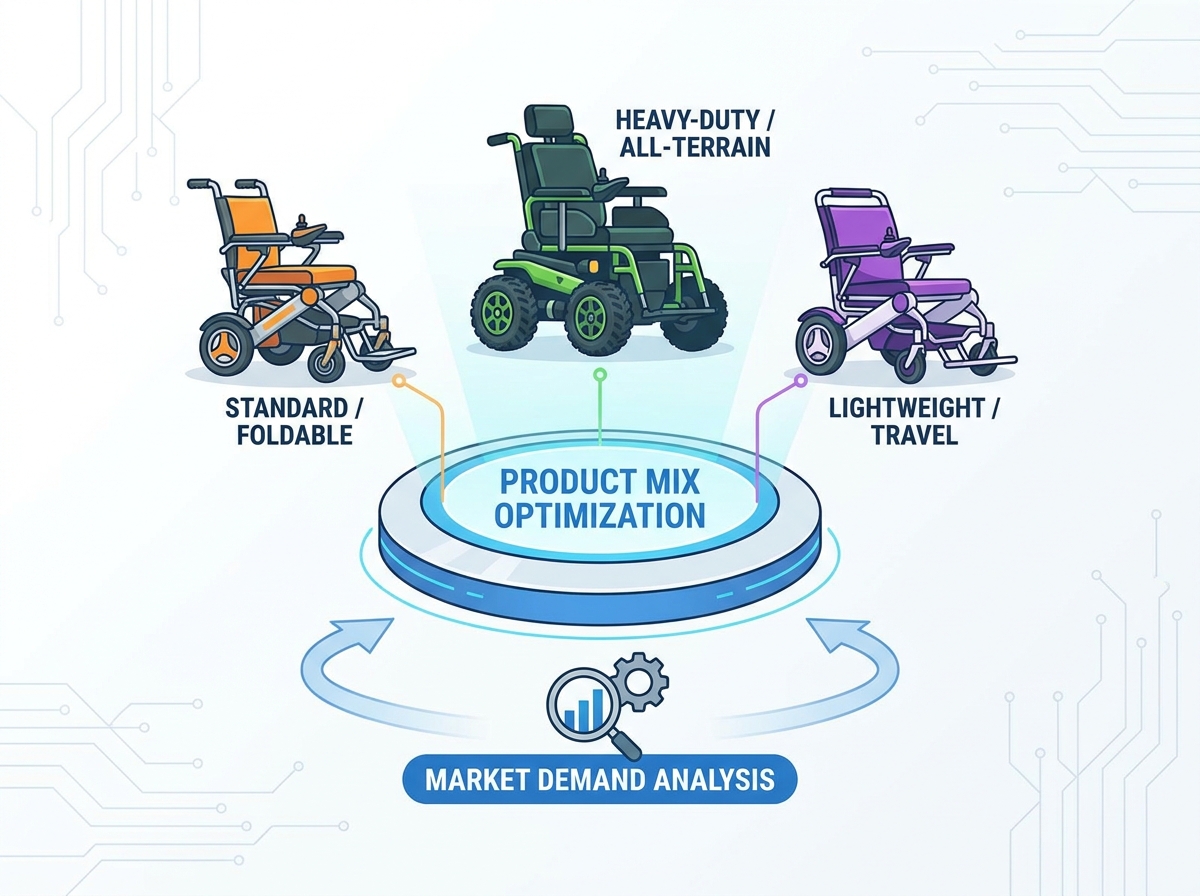
Evaluating Wholesale Electric Wheelchairs: Sourcing and Scalability
Analyzing the financial and operational trade-offs when selecting manufacturing partners dictates the long-term viability of your mobility business. Sourcing reliable wholesale electric wheelchairs requires looking past the initial unit cost and evaluating the entire supply chain ecosystem.
Manufacturer Reliability and Supply Chain Transparency
A supplier's ability to deliver consistent inventory directly impacts your sales floor. You must assess lead times, domestic warehousing capabilities, and historical fulfillment rates. Relying solely on offshore sourcing without domestic distribution hubs introduces significant hidden costs. Extended shipping delays, customs hold-ups, and inconsistent inventory flow can leave your showroom empty and force customers to seek alternatives.
Minimum Order Quantities (MOQs) vs. Just-in-Time Fulfillment
Inventory management is a constant balancing act between securing bulk purchasing discounts and managing the cost of warehousing large units. High MOQs tie up capital and consume valuable storage space. Conversely, evaluating drop-shipping programs offered by wholesale partners allows you to expand your catalog offerings without massive upfront capital expenditure. Drop-shipping enables you to offer specialized models while keeping your physical floor space optimized for high-turnover standard units.
Margin Analysis Across Product Tiers
Understanding true profitability requires calculating the Total Cost of Goods Sold (COGS) comprehensively. This calculation must include inbound freight, the labor time required for assembly and pre-delivery inspection, and projected warranty labor. A chair with a low wholesale price but high assembly requirements and frequent warranty claims will ultimately yield a lower net margin than a slightly more expensive, highly reliable unit that is ready for the floor out of the box.
Technical Evaluation Dimensions for Retailers
Vetting the quality of a power chair before adding it to your mix requires applying industry-standard technical lenses. You must evaluate the internal components and structural design to ensure the products will perform reliably in the real world.
Battery Technology, Range Capabilities, and Charging Logistics
Power sources define the usability of the chair. You must weigh the trade-offs between Sealed Lead Acid (SLA) and Lithium-Ion batteries. SLA batteries are cost-effective and reliable but heavy and possess shorter lifespans. Lithium-Ion batteries offer significant weight reduction and longer life cycles, making them essential for travel models, though they carry strict shipping regulations.
Always evaluate real-world range claims against manufacturer specifications to manage customer expectations accurately. Furthermore, consider charging dynamics. Assess whether the chairs feature off-board or on-board chargers, review standard charge times, and ensure the presence of auto-shutoff features to preserve battery health and prevent overcharging.
Drive Systems and Environmental Suitability
The placement of the drive wheels fundamentally alters the physics and handling of the chair. Matching the drive system to the user's environment is non-negotiable.
Mid-Wheel Drive: Features the drive wheels directly under the user's center of gravity. This provides the tightest turning radii, making it the absolute best choice for indoor use and navigating narrow urban environments.
Rear-Wheel Drive: Offers superior directional stability, especially at higher speeds. It performs exceptionally well on outdoor terrain, though it requires a much larger turning radius indoors.
Front-Wheel Drive: Provides optimal obstacle climbing capabilities, easily handling curbs and door thresholds. It offers excellent varied indoor/outdoor transitions and allows the user to pull up closer to desks and tables.
Seating Systems, Ergonomics, and Customization Capabilities
Inventory efficiency increases when a single base model can serve multiple patient profiles. Evaluate the modularity of the chair: Can the base accommodate aftermarket cushions, elevating leg rests, or alternative joystick placements? Stocking models with multi-position adjustable armrests, adjustable seat-to-floor heights, and tension-adjustable backrests allows you to accommodate diverse patient body types with fewer stock-keeping units (SKUs), significantly lowering overall warehousing costs.
Control Interfaces & Drive Electronics
The user interface dictates the daily experience. Evaluate the responsiveness of standard joysticks and check for the availability of companion or attendant controllers for caregivers. Advanced models should offer custom programming software to adjust acceleration and turning sensitivity based on the user's motor skills. Additionally, evaluate modern features like Bluetooth connectivity, electronic speed limiters, and clear diagnostic display readouts that help users monitor battery life and system health.
Safety Architecture & Dynamic Stability
Safety mechanisms must be rigorously tested. Verify the response times of electronic regenerative disk brakes and electromagnetic braking mechanisms to ensure the chair stops smoothly and securely, even on inclines. Analyze stability metrics, including maximum safe slope incline ratings, obstacle climbing limits, and the design and placement of anti-tip wheels to prevent backward falls during aggressive acceleration or incline navigation.
Implementation Risks and After-Sales Mitigation
Protecting your business reputation and bottom line after the sale is complete requires proactive risk management. The true cost of a mobility device includes the effort required to keep it running.
Warranty Structures and Parts Availability
Analyze the fine print of every manufacturer agreement. Understand the distinct warranty durations for the frame, the motors, and the batteries. The critical importance of a supplier's spare parts portal cannot be overstated. Fast parts-shipping SLAs ensure that when a customer's chair breaks down, you can get them mobile again quickly, preserving your local reputation.
Technical Support and Servicing Requirements
Assess the complexity of in-house repairs and component replacement for the models you stock. Evaluate whether the wholesale partner provides comprehensive diagnostic software, detailed service manuals, and dedicated dealer technical support lines. A supplier that abandons you after the initial wholesale purchase will drain your service department's resources.
Regulatory Compliance and Certifications
Ensure all stocked models meet stringent regulatory standards. Verify FDA requirements for the US market, CE marks for Europe, or relevant local certifications. Furthermore, if you are operating as a DME provider, you must thoroughly understand the coding and documentation required for Medicare or Medicaid billing to ensure smooth reimbursement processes.
Request compliance documentation from all suppliers before signing purchase agreements.
Train your service technicians on the specific diagnostic software used by your chosen manufacturers.
Establish a dedicated quarantine area in your warehouse for units awaiting warranty parts.
Conclusion
A successful electric wheelchair product mix is not about carrying every model available, but curating a targeted selection that directly answers the demographic realities of your specific market. By aligning your inventory with the actual environments and physical needs of your local customer base, you optimize floor space and increase inventory turnover. Prioritize wholesale partners who offer a strategic mix of reliable entry-level travel chairs, high-tech smart models, and robust daily-use chairs.
Audit your current floor inventory to identify slow-moving units and categorize them by drive type and target demographic.
Analyze the last 12 months of lost sales or special orders to pinpoint exact gaps in your product offerings.
Request sample units from top-tier wholesale suppliers to physically test build quality, packaging, and service responsiveness before committing to large orders.
Restructure your showroom layout to clearly delineate travel, standard, and heavy-duty models, making the selection process intuitive for walk-in customers.
FAQ
Q: What is the most profitable type of electric wheelchair for retail?
A: Profitability requires a balanced mix. High-volume travel chairs generate steady cash flow with lower margins, while bariatric and specialty chairs offer higher margins per unit. Additionally, the growing smart PMD segment is highly profitable, capturing premium private-pay dollars from design-conscious consumers.
Q: How do I choose a supplier for wholesale electric wheelchairs?
A: Look beyond the base unit price. Prioritize suppliers with domestic parts availability, clear and comprehensive warranty terms, flexible drop-ship capabilities, and reasonable Minimum Order Quantities (MOQs) that do not strain your warehousing capacity.
Q: What is the difference between standard and complex rehab electric wheelchairs?
A: Standard mobility chairs are designed for general daily use and basic comfort. Complex rehab chairs feature highly customized seating systems, specialized drive electronics, and alternative drive controls, requiring specialized clinical evaluations and custom fittings for severe disabilities.
Q: Which drive system is best for indoor vs. outdoor use?
A: Mid-wheel drive is best for indoor use due to its extremely tight turning radius. Rear-wheel and front-wheel drives perform better outdoors, offering superior directional stability at higher speeds and better obstacle climbing capabilities, respectively.
Q: What are the standard warranty terms for wholesale power mobility devices?
A: Industry standards typically offer a lifetime warranty on the structural frame, 1 to 2 years of coverage on motors and drive electronics, and 6 to 12 months of coverage on the batteries.
Q: How do lithium-ion batteries impact the shipping and storage of power chairs?
A: Lithium-ion batteries are subject to strict hazardous materials shipping regulations, which can complicate and delay freight. They also require temperature-controlled storage environments to prevent degradation and maintain maximum charging capacity over time.
Q: Why is seating adjustability critical for managing electric wheelchair inventory?
A: Adjustable seat width, depth, and height-to-floor ratios allow a single chair SKU to serve multiple patient profiles. This flexibility significantly lowers overall warehousing costs and reduces the amount of capital tied up in highly specific, single-size inventory.

Get our 2026 Product Catalogue & Book a VIP Meeting
Leave your contact information and our online customer service will contact you shortly.
Reserve a 15-min VIP Consultation with our Engineering Lead. The number of places is limited.
