

 English

The frame material of an electric wheelchair dictates more than just the end-user experience; it fundamentally drives shipping economics, profit margins, and warranty claim rates for distributors. Wholesale buyers and medical equipment distributors must balance unit cost, structural durability, and weight capacity when stocking mobility aids. Committing to the wrong frame material can result in dead stock, prohibitive freight costs, or increased structural failures in the field. Procurement teams need an objective, evidence-based breakdown of steel versus aluminum frames to determine the optimal inventory mix. Understanding the specific metallurgical advantages and logistical impacts of each material allows buyers to calculate total landed costs accurately and align product specifications with targeted market demands. You must evaluate how raw material selection impacts everything from factory floor assembly to last-mile delivery logistics.
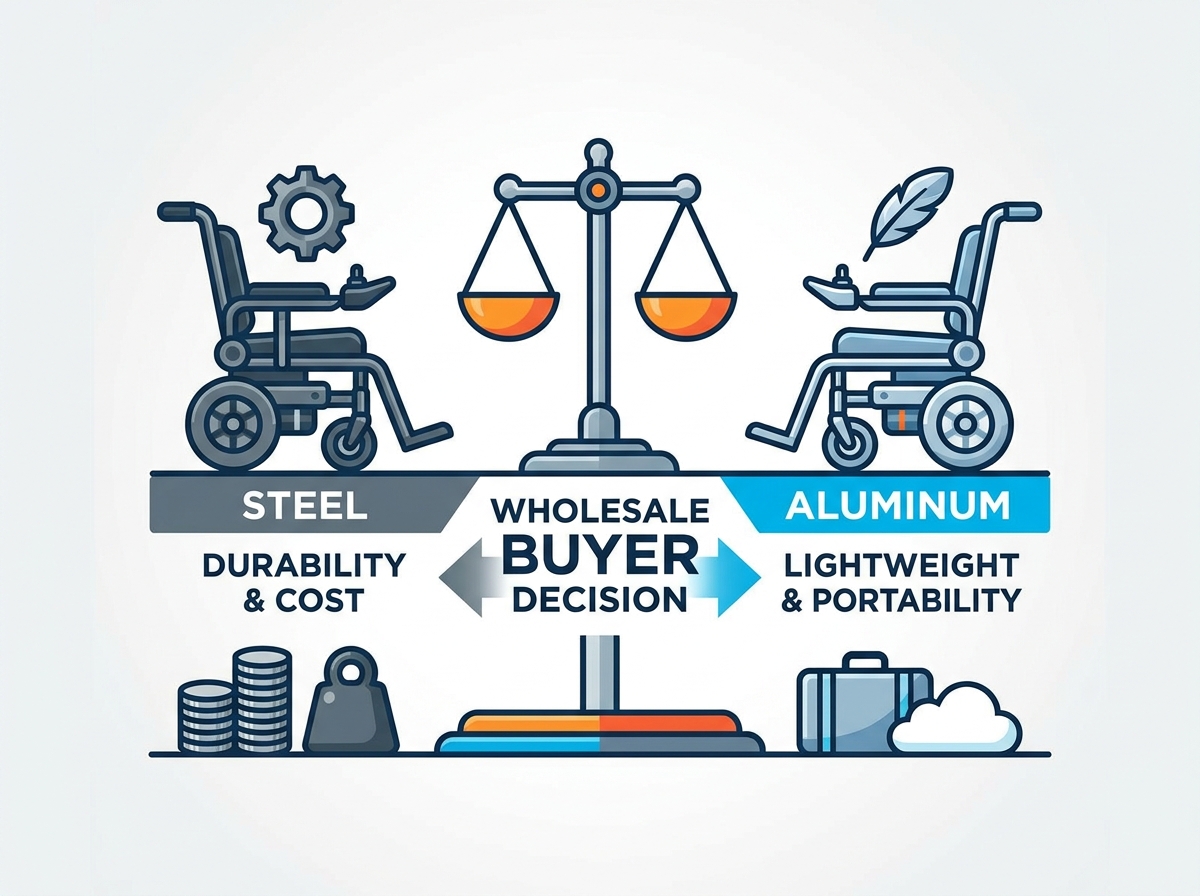
Aluminum frames offer a 20–35% weight reduction compared to steel, significantly lowering freight costs and dominating the travel, elderly, and portability market segments.
Steel frames provide superior high-weight capacity (crucial for bariatric models) and lower upfront manufacturing costs, though they incur higher shipping and handling fees.
Caregiver lifting and transport ergonomics are primary drivers of retail demand; lightweight aluminum chairs reduce physical strain during vehicle loading, leading to faster retail turnover.
Aluminum’s natural corrosion resistance reduces long-term maintenance claims in humid or coastal climates, whereas steel requires robust, high-quality powder coating to prevent rust.
Optimal wholesale purchasing strategies require a tiered inventory approach, matching frame materials to specific end-user demographics, regional environmental factors, and consumer retail pricing thresholds.
Framing the Procurement Problem: Success Criteria for Wholesale Mobility Distributors
Analyzing total landed cost versus retail margins requires looking far beyond the factory gate. Raw material costs and manufacturing complexity dictate the initial unit price, but international freight dimensions and weight significantly impact final profitability. Heavier mobility units consume more fuel to transport and often trigger dimensional weight penalties during domestic fulfillment. Distributors must calculate these logistical overheads to understand the true cost of inventory. When a shipping container is loaded with heavy steel frames, the maximum weight limit of the container is often reached long before the physical volume is filled. This results in shipping empty space, which destroys freight efficiency. Conversely, lighter frames allow procurement teams to maximize the volumetric capacity of every container, driving down the per-unit shipping cost.
Retail pricing thresholds directly influence end-user affordability and sell-through rates. Aluminum models command a retail price premium due to higher raw material and welding costs. Distributors must evaluate whether their target market can absorb this premium. Budget-friendly steel models often capture high-volume, price-sensitive markets, particularly in regions where upfront affordability outweighs the need for daily portability. You have to map your inventory to the purchasing power of your specific regional demographics. Stocking premium lightweight models in a market dominated by institutional buyers looking for basic fleet replacements will result in stagnant inventory.
Matching frame material to target demographics is a mandatory inventory strategy. The elderly and travel segments prioritize portability and caregiver lifting ease, making lightweight frames non-negotiable. Conversely, institutional or bariatric users prioritize structural rigidity and high load-bearing capacity, where heavier frames provide necessary stability. Misaligning the product with the demographic leads to high return rates and poor customer satisfaction. A bariatric user placed in a standard aluminum chair risks frame failure, while an elderly user provided with a heavy steel chair will likely return it due to an inability to load it into a vehicle.
Warranty and lifecycle considerations heavily influence procurement decisions. Frame material impacts structural fatigue over time and the cost of replacement parts. Distributors must project the long-term return rates associated with weld failures or environmental degradation. A cheaper frame that fails prematurely will erode margins through warranty claims and damage brand reputation. Tracking the failure rates of specific weld joints across different materials provides actionable data for future purchasing cycles.
Aluminum Electric Wheelchairs: Performance, Costs, and Market Fit
Examining the material properties and engineering realities of aluminum reveals why it dominates specific mobility sectors. Manufacturers typically utilize aerospace-grade alloys, such as 6061-T6, which offer an exceptional strength-to-weight ratio. This allows engineers to design frames that withstand daily operational stress without adding unnecessary bulk. The T6 tempering process involves solution heat-treating and artificially aging the metal, which significantly increases its yield strength. This means the frame can absorb impacts and vibrations from uneven sidewalks without permanently deforming.
The freight and logistics advantages of a lighter chassis are substantial. A reduced overall weight optimizes shipping container loads and lowers dimensional weight pricing during last-mile delivery. Warehouse handling efficiency also improves, as staff can move and stack boxed units with less physical exertion and reduced risk of workplace injury. When warehouse teams process inbound shipments, lighter cartons mean faster unloading times, fewer required personnel per container, and a lower incidence of dropped or damaged merchandise during palletization.
Lifting and transport ergonomics dictate retail success in the consumer market. Aluminum's lower physical weight translates to practical daily benefits. Caregivers and users can easily fold and lift the chair into a vehicle trunk. If a mobility device is too heavy for a single person to load into a standard sedan, retail turnover will stagnate. The physical strain placed on a caregiver is a primary reason for product returns within the first thirty days of purchase. By stocking lighter frames, distributors directly address the most common point of friction in the end-user experience.
Corrosion resistance plays a major role in post-sale maintenance. Aluminum naturally forms an oxidation barrier that prevents structural rust. This characteristic significantly lowers service costs and warranty claims in humid or coastal environments, where moisture rapidly degrades unprotected metals. When the surface of an aluminum frame is scratched, the exposed metal immediately reacts with oxygen to form a microscopic layer of aluminum oxide, sealing the scratch and preventing further degradation. This self-healing property is a massive advantage for long-term fleet durability.
Aluminum is the mandatory standard for folding, travel-friendly, active, and standard-use mobility chairs. The target end-user profile for these models demands independence and mobility outside the home, which is only achievable with a lightweight, easily transportable frame. Active users frequently navigate public transit, load chairs into personal vehicles, and travel by air. These activities require a frame that can be quickly collapsed and maneuvered without specialized lifting equipment.
Sourcing Steel Electric Wheelchairs for Wholesale: Durability and High-Capacity Demands
Structural integrity is the primary reason distributors continue to stock steel frames. Carbon and alloy steel offer distinct metallurgical advantages in preventing frame flex under heavy loads. This rigidity makes steel the industry standard for heavy-duty and bariatric models, ensuring user safety and product longevity under extreme weight conditions. Steel possesses a higher modulus of elasticity than aluminum, meaning it bends less under the same amount of force. This stiffness is critical when supporting users over 350 pounds, as excessive frame flex can misalign the drive wheels and cause premature wear on the motors and transaxles.
Cost-efficiency in manufacturing remains a strong incentive. Steel features lower raw material costs and simpler welding processes compared to aluminum. When sourcing steel electric wheelchairs for wholesale, buyers can often negotiate aggressive bulk pricing and lower Minimum Order Quantities. This allows distributors to serve budget-conscious markets effectively. The MIG welding process used for steel is faster and requires less specialized shielding gas than the TIG welding typically required for aluminum, driving down factory labor costs and increasing production throughput.
The heavy-duty folding dilemma presents specific engineering tradeoffs. Balancing the need for collapsible storage with the structural weight limits of foldable joints is challenging. Heavy-duty folding steel models must utilize reinforced hinges and locking mechanisms, which add further weight to the unit but are necessary to maintain structural integrity during use. A folding cross-brace on a bariatric steel chair must be manufactured from thick-walled tubing and secured with high-tensile steel bolts to prevent catastrophic failure during lateral shifts in user weight.
Maintenance and environmental vulnerabilities require careful consideration. Steel carries inherent rust risks. Evaluating the necessity of multi-layer powder coating is essential during the procurement phase. Frame scratches in the field expose raw steel to moisture, leading to rapid oxidation if the factory coating is inadequate. Procurement teams must verify that manufacturers utilize a proper chemical pretreatment process, such as iron phosphate washing, before applying the powder coat. Without this pretreatment, the paint will eventually flake off, exposing the steel to the elements.
Distributors should position steel models toward institutional buyers, rental fleets, long-term care facilities, and budget-conscious consumer segments. In these environments, portability is rarely the primary purchase driver; instead, durability, high weight capacity, and low initial acquisition costs dictate the buying decision. A rental fleet operator prioritizes a chair that can withstand daily abuse from multiple users without requiring frequent frame repairs, making heavy-duty steel the logical choice for that specific business model.
Head-to-Head Evaluation Dimensions: Steel vs. Aluminum
A comparative analysis of average chair weight against maximum user weight limits highlights the core trade-offs between the two materials. Steel frames easily support user weights exceeding 400 pounds but often push the total chair weight past 100 pounds. Aluminum frames keep the total chair weight under 60 pounds but generally cap user weight limits around 250 to 300 pounds. You must map these specifications directly to your historical sales data to determine the correct ratio of materials to stock.
Frame material directly impacts battery efficiency and range. The heavier mass of a steel frame creates higher rolling resistance. This requires larger, heavier batteries to achieve the same operational range as a lighter aluminum counterpart, further increasing the total weight of the unit. The physics of moving a heavier object require more amperage from the controller, which generates more heat and drains the battery cells faster. This means steel chairs often require higher-capacity sealed lead-acid or large lithium packs just to match the baseline range of a lighter chair.
Assessing long-term durability involves evaluating weld fatigue. TIG-welded aluminum joints offer clean, strong bonds but can be susceptible to cracking under continuous, heavy-impact stress if the frame design lacks proper gusseting. MIG-welded steel joints provide superior resistance to repeated heavy loads, making them better suited for institutional environments where equipment faces rough handling. Steel's natural ductility allows it to absorb minor impacts without fracturing the weld bead, whereas aluminum's rigidity can cause stress concentrations at the weld toes.
| Evaluation Metric | Aluminum Alloy Frames | Carbon Steel Frames |
|---|---|---|
| Base Frame Weight | Significantly lighter, optimizing freight and handling | Heavy, increasing dimensional shipping costs |
| Maximum Load Capacity | Standard consumer limits (250-300 lbs) | Bariatric and institutional limits (400+ lbs) |
| Corrosion Resistance | Excellent (Natural oxidation barrier protects metal) | Poor (Requires multi-layer powder coating) |
| Battery Drain Rate | Lower rolling resistance extends operational range | Higher mass increases motor load and battery drain |
| Weld Fatigue Resistance | Requires precise TIG welding and gusseting | High ductility absorbs impact without weld fracture |
A structured framework mapping materials directly to specific consumer personas ensures accurate procurement. Elderly travelers require aluminum for trunk loading. Bariatric patients require steel for safety and stability. Active outdoor users benefit from aluminum's agility. Institutional rehabilitation centers rely on steel's durability against daily abuse. By categorizing your purchasing orders based on these distinct personas, you eliminate the risk of stocking generic inventory that fails to meet the specific needs of any single demographic.
Alternative Frame Materials: Where Carbon Fiber Fits the Mix
Carbon fiber represents the ultra-lightweight premium tier in mobility manufacturing. It offers maximum strength with an absolute minimum weight footprint, often resulting in chairs that weigh less than 40 pounds fully assembled. This material caters to a highly specific market segment. The manufacturing process involves laying sheets of carbon fabric into molds and curing them under high pressure and heat with epoxy resins. This creates a monocoque structure that is incredibly rigid and exceptionally light.
When evaluating carbon fiber versus aluminum for active users, carbon fiber serves niche athletic and high-mobility individuals. These users require ultra-lightweight performance for frequent travel and independent vehicle loading. They demand a chair that responds instantly to joystick inputs without the lag caused by frame flex or excess weight. Carbon fiber dampens vibrations from rough terrain better than metal frames, providing a smoother ride over cobblestones or cracked pavement.
High manufacturing costs restrict carbon fiber to premium retail segments. The complex fabrication process limits its viability for high-volume wholesale distribution. For most distributors, aluminum remains the most balanced choice for lightweight inventory, offering a better intersection of affordability and portability. Carbon fiber frames cannot be easily modified or welded if damaged; a cracked carbon frame usually requires complete replacement, which complicates warranty support and aftermarket service for distributors.
Implementation Risks and Inventory Mitigation Strategies
Managing freight damage requires understanding material behaviors during transit. Steel frame rigidity can transfer impact forces directly to sensitive electronic components, necessitating heavy-duty internal packaging. Conversely, aluminum is more susceptible to cosmetic denting or bending if dropped. Distributors must audit supplier packaging standards to mitigate these risks. You should require manufacturers to use custom-molded EPS foam inserts rather than generic bubble wrap to isolate the frame from the edges of the shipping carton.
Structuring inventory based on regional demand variations prevents dead stock. Distributors servicing coastal areas or regions with high humidity should prioritize aluminum models due to salt-air corrosion risks. Inland or institutional distributors can safely stock higher volumes of steel units. Analyzing historical sales data by zip code allows procurement teams to build a geographic heat map of material preferences, ensuring regional warehouses are stocked with the appropriate frame types.
Balancing MOQs across material types protects capital. Negotiate mixed-container loads with overseas manufacturers to test market demand. Sourcing a container split between standard aluminum models and heavy-duty steel units allows distributors to serve multiple demographics without over-leveraging capital on a single material type. This strategy provides a buffer against sudden shifts in consumer preference and allows you to maintain a diverse product catalog without tying up excessive warehouse space.
To effectively manage quality control upon receipt of mixed containers, implement a rigorous inbound inspection protocol. This ensures that factory standards are maintained across different material lines.
Pull one random unit from every fifty cartons unloaded from the container.
Inspect all TIG welds on aluminum frames for porosity or incomplete penetration.
Test the powder coat adhesion on steel frames using a standard cross-hatch cutter tool.
Verify that the folding mechanisms operate smoothly without binding or excessive play.
Document any deviations from the approved engineering specifications and report them to the manufacturer immediately.
Conclusion
Aluminum dominates the standard consumer, travel, and active-user segments due to favorable logistics and a strong user preference for portability. Steel remains an essential, cost-effective requirement for bariatric, institutional, rental, and heavy-duty applications. Procurement decisions should rely on auditing current customer return data, analyzing localized freight costs, and segmenting target buyers before committing to manufacturer MOQs. You must align your purchasing strategy with the physical realities of the materials and the logistical constraints of your distribution network.
Request detailed material specification sheets and weld-testing certifications from all potential suppliers before issuing purchase orders.
Order sample units of both steel and aluminum materials for internal quality assurance and physical teardown analysis.
Calculate the total landed cost per unit, strictly factoring in dimensional weight freight charges and projected warranty reserves.
Segment your retail network to ensure you are pushing the right frame material to the appropriate demographic based on regional data.
FAQ
Q: What is the average weight difference between steel and aluminum electric wheelchairs?
A: Aluminum frames are typically 20% to 35% lighter than their steel counterparts. A standard aluminum model often weighs between 40 and 60 pounds, while a comparable steel model usually exceeds 80 to 100 pounds, significantly impacting portability and lifting ease.
Q: Are steel electric wheelchairs for wholesale cheaper to import than aluminum models?
A: Yes, the raw material and manufacturing costs for steel are lower, resulting in a cheaper initial unit price. However, buyers must factor in higher shipping costs due to the increased weight, which can offset some of the upfront savings.
Q: Which electric wheelchair frame material is best for bariatric users?
A: Steel is the industry standard for bariatric users. Carbon and alloy steel provide superior structural rigidity and weld strength, safely supporting higher weight capacities without frame flex or failure.
Q: Do aluminum electric wheelchairs rust or corrode over time?
A: Aluminum does not rust. It naturally forms an oxidation barrier that protects the metal from environmental degradation. This makes aluminum highly resistant to corrosion, even in humid or coastal climates, reducing long-term maintenance needs.
Q: How does the frame material impact the battery life and range of an electric wheelchair?
A: Heavier steel frames increase rolling resistance, requiring more power to move. This drains the battery faster, resulting in a shorter operational range compared to a lighter aluminum chair using the exact same battery capacity.
Q: Can I order mixed containers of steel and aluminum wheelchairs from overseas manufacturers?
A: Yes, many overseas manufacturers allow mixed-container loads. Negotiating a split container helps wholesale buyers balance their inventory across different demographics without committing to massive minimum order quantities for a single material type.
Q: How do carbon fiber electric wheelchairs compare to aluminum models in wholesale pricing?
A: Carbon fiber models are significantly more expensive at the wholesale level due to complex, labor-intensive manufacturing processes. While they offer the lowest weight possible, their high cost restricts them to premium retail segments.

Get our 2026 Product Catalogue & Book a VIP Meeting
Leave your contact information and our online customer service will contact you shortly.
Reserve a 15-min VIP Consultation with our Engineering Lead. The number of places is limited.
