

 English

In the durable medical equipment sector, initial margins are often eroded by the hidden costs of poor after-sales support and extended equipment downtime. Distributors face significant reputational and financial risks when end-users experience mobility loss due to delayed spare parts, incompatible components, or unresponsive manufacturers. Establishing a profitable distribution model requires shifting from reactive repairs to proactive inventory planning. This guide provides a framework for evaluating manufacturer support infrastructure and structuring a resilient after-sales pipeline before signing a distribution agreement. When a mobility device fails, the end-user loses their independence. If your service team cannot source the right components immediately, that delay damages your brand reputation permanently. You need a robust strategy to handle parts procurement, inventory management, and warranty claims efficiently. We will walk through the exact steps to build a reliable parts pipeline, ensuring your service department operates smoothly and your clients remain mobile.
Pre-Order Requisite: Spare parts planning must occur concurrently with initial commercial orders, requiring verified part numbers, high-resolution visual catalogs, and compatibility matrices.
Inventory Stratification: Successful distributors categorize inventory into high-wear consumables, upgrade accessories, critical electronics, and structural hardware to optimize capital allocation.
Supplier Vetting: An ideal electric wheelchair manufacturer for distributors provides transparent warranty claim processes, guaranteed lead times for replacement components, regulatory certifications (ISO 13485, CE/FDA), and standardized diagnostic protocols.
Risk Mitigation: Cross-compatibility issues, international shipping compliance for lithium batteries, and battery degradation in storage are the leading causes of after-sales friction; mitigating these requires strict vendor evaluation and internal auditing.
The Strategic Role of After-Sales Support in Distribution
Defining Success Criteria for Post-Purchase Operations
Success in mobility distribution extends far beyond the initial sale. Shifting focus from unit-sales metrics to lifetime-value and service-level agreement adherence ensures long-term profitability. Rapid repair turnarounds directly influence contract renewals with hospitals, clinics, or regional retailers. When an electric wheelchair remains operational, client trust solidifies. You must track mean time to repair and first-time fix rates to gauge the effectiveness of your service department. A well-stocked parts room allows technicians to resolve issues in a single visit, drastically reducing labor overhead and improving client satisfaction metrics.
The Financial Impact of Reactive Parts Sourcing
Relying on reactive parts sourcing drains capital. Expedited shipping for single components costs significantly more than bulk pre-ordering. Furthermore, labor costs escalate when technicians wait on undocumented or incompatible parts. Proactive inventory management eliminates these avoidable expenses.
| Sourcing Strategy | Shipping Costs | Equipment Downtime | Technician Efficiency |
|---|---|---|---|
| Reactive Sourcing | High (Expedited air freight) | 7 to 14 days average | Low (Multiple site visits required) |
| Proactive Inventory | Low (Consolidated ocean freight) | Same-day or next-day | High (Single-visit resolution) |
Categorizing Replacement Parts and Value-Add Accessories
High-Wear Consumables (Predictable Replacements)
Certain components follow standard degradation curves. Pneumatic and solid tires, caster wheels, armrest pads, and footrest assemblies require regular replacement. Stocking these items based on projected local terrain and user demographics prevents service delays. You should analyze the specific environments where your fleet operates. Rough outdoor terrain accelerates tire and caster wear, while indoor facility use might see more frequent damage to armrests and footplates from doorway collisions.
Pneumatic drive tires and inner tubes.
Solid polyurethane caster wheels.
Urethane armrest pads.
Swing-away footrest latch mechanisms.
Comfort-Enhancing Upgrades and Accessories (Marginal Upcharges)
Specialized seating cushions, tension-adjustable backrests, and ergonomic armrests offer strong monetization potential. Stocking positioning accessories resolves custom user ergonomic needs while generating high-margin cross-sales. Technicians can often upsell these items during routine maintenance visits if they have the inventory readily available in their service vehicles.
Critical Electronic Components (High-Priority Uptime)
Stocking joystick controllers, wiring harnesses, and primary motors is crucial for maintaining uptime. Holding expensive electronic inventory requires balancing capital outlay against the risks of relying on manufacturer drop-shipping. A failed joystick grounds the entire device immediately. Maintaining a localized buffer stock of these critical electronics ensures you can restore mobility within 24 hours, rather than waiting weeks for international replacements.
Power Systems and Battery Management
Storing and replacing lithium-ion versus Sealed Lead Acid batteries involves distinct logistical requirements. Shelf-life management, maintenance charging cycles, and mitigating the risks of dead-on-arrival replacement batteries demand strict protocols. Lithium batteries require specific ambient temperature controls and periodic voltage checks to prevent deep discharge degradation while sitting on warehouse shelves.
Structural and Hardware Elements (Low-Frequency, High-Impact)
Frame components, shroud covers, and seating mechanisms fail less frequently but cause severe downtime. Strategies for cannibalizing damaged units often prove more efficient than ordering specialized structural parts. Keeping a few decommissioned units in the back of the warehouse provides a rapid source for obscure hardware, bolts, and brackets that might otherwise take months to source from the factory.
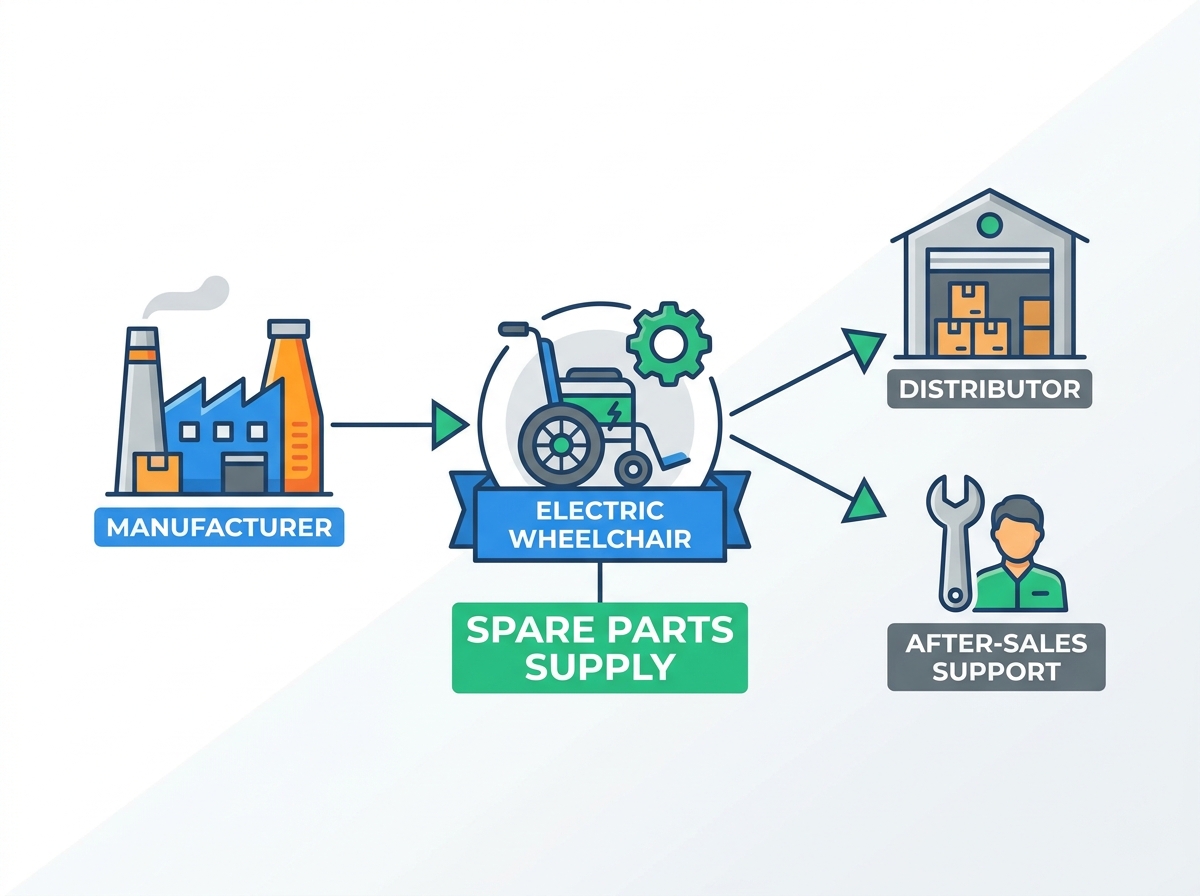
Evaluating a Manufacturer for Distributors
Regulatory Compliance and Factory Certifications
Manufacturer-level quality standards, such as ISO 13485 medical device quality management systems, are non-negotiable. Verifying FDA clearance or CE markings for core models and replacement parts ensures hassle-free customs clearance. An ideal electric wheelchair manufacturer for distributors will provide these compliance documents proactively during the initial vetting phase.
Supply Chain Transparency and Parts Availability
Evaluating a manufacturer's supply chain requires assessing guaranteed parts availability windows and average lead times. Auditing domestic warehousing capabilities versus overseas shipping dependencies reveals potential bottlenecks. You need written guarantees that parts will remain in production for a minimum of five years after a specific model is retired from the active catalog.
Warranty Terms and Claim Resolution Architecture
Standard warranty agreements must separate frame warranties from electronics and consumables. A reliable claim process includes clear RMA generation, diagnostic proof requirements, and defined credit versus replacement policies. The workflow should be entirely digital, allowing your service managers to upload diagnostic videos and receive RMA approval within 48 hours.
Technical Documentation and Diagnostic Support
Baseline documentation requirements include exploded view diagrams, high-resolution parts photos, standardized part numbering systems, and backward compatibility charts. Direct-to-technician support channels, remote video diagnostics, and proprietary software tools streamline repairs. Without accurate exploded diagrams, your technicians will waste hours guessing part numbers, leading to incorrect orders and extended downtime.
Structuring Your Initial Spare Parts Inventory
The "Pre-Commercial Order" Strategy
Negotiating a spare parts package as a mandatory inclusion in the initial container order establishes a strong foundation. Locking in spare parts price lists for 12 to 24 months post-purchase prevents unexpected cost escalations. Initial order negotiations should also secure discounted rates on diagnostic kits, visual assembly guides, and high-wear items. Never accept a container of finished goods without a corresponding allocation of critical spares packed inside.
Calculating Stock-to-Sales Ratios
Determining initial parts volume requires a realistic mathematical approach based on the deployed fleet size. Adjusting ratios based on the target market, such as heavy outdoor use versus indoor facility use, optimizes inventory levels. A common baseline is allocating five percent of the total container value strictly to replacement components, heavily weighted toward tires, batteries, and joysticks.
Implementation Risks and Mitigation Strategies
Managing Cross-Compatibility Across Model Years
Manufacturers sometimes update components silently, changing motor mounts or controller pinouts without updating part numbers. Requiring strict version control documentation and batch-tracking from the supplier mitigates this risk. You must implement a receiving protocol that visually verifies incoming parts against the existing fleet to catch silent revisions before they reach the field.
Technician Training and Quality Control
Improper installation leads to secondary failures. Mandating factory-certified training programs or comprehensive video SOPs from the manufacturer before deploying new models ensures quality control. A poorly routed wiring harness will eventually chafe and short out, turning a simple repair into a catastrophic electronic failure.
Customs Compliance and Hazardous Materials Transport
Importing lithium-ion batteries and heavy assemblies involves strict customs challenges. Ensuring the manufacturer provides comprehensive UN38.3 testing reports, Material Safety Data Sheets, and compliant dangerous goods packaging prevents border delays. Missing battery documentation will result in immediate customs holds and potential confiscation of the entire shipment.
Regulatory Compliance and Safety Standards
Using aftermarket or non-OEM parts on FDA/CE-certified medical devices introduces severe compliance risks. Establishing strict internal procurement rules that prioritize OEM components for critical electrical and structural repairs preserves regulatory integrity and product liability coverage. Modifying a device with unapproved electronics transfers the liability entirely onto your distribution business.
Conclusion
Long-term profitability in mobility distribution hinges entirely on the efficiency of the after-sales infrastructure, not just the initial unit margin. Select a manufacturing partner that treats spare parts and regulatory transparency as core operational pillars. To establish a resilient service department, execute the following steps immediately:
Request exploded parts diagrams and standardized part numbering lists from prospective manufacturers.
Negotiate a locked-in spare parts agreement for 24 months prior to signing the main distribution contract.
Allocate a specific percentage of your initial container order exclusively for high-wear consumables and critical electronics.
Implement a strict warehouse protocol for maintaining and charging lithium-ion battery inventory.
FAQ
Q: What is the standard warranty period an electric wheelchair manufacturer should offer distributors?
A: Standard warranties typically cover the frame for 3 to 5 years, while motors and controllers carry a 1-year warranty. Batteries usually have a 6-month to 1-year warranty. Clarifying these terms upfront prevents disputes.
Q: How do I determine which spare parts to order with my first container?
A: Apply the 80/20 rule, focusing on high-wear items like tires, joysticks, batteries, and common visual wear components such as armrests. This covers the majority of initial service requests.
Q: Can I use aftermarket parts for electric wheelchair repairs?
A: Using aftermarket parts risks voiding the warranty, increasing liability, and compromising medical device regulatory compliance. Always prioritize OEM parts for critical repairs.
Q: How long should a manufacturer guarantee spare parts availability after a model is discontinued?
A: Industry standards dictate that manufacturers should guarantee spare parts availability for 5 to 7 years after a model is discontinued to support the product's expected lifespan.
Q: What documentation is required to process a warranty claim efficiently?
A: Efficient claims require serial numbers, diagnostic videos or photos clearly showing the defect, and standardized RMA forms submitted through the manufacturer's portal.
Q: How should distributors store replacement lithium-ion batteries?
A: Store lithium-ion batteries in a temperature-controlled environment, maintain a 50% state-of-charge, implement periodic recharge schedules, and enforce strict fire safety protocols.

Get our 2026 Product Catalogue & Book a VIP Meeting
Leave your contact information and our online customer service will contact you shortly.
Reserve a 15-min VIP Consultation with our Engineering Lead. The number of places is limited.
