

 English


Procuring essential medical furniture often involves balancing upfront budget constraints against complex logistical realities. Purchasing hospital beds in a "knock-down" or unassembled configuration effectively reduces initial freight expenses. However, this strategy directly shifts labor requirements and implementation risks onto the buyer. A successful acquisition strategy demands careful evaluation of these upfront unit savings compared to internal assembly capabilities, facility site-preparation needs, and potential hidden delivery surcharges. This article provides a transparent, evidence-based framework for assessing knock-down bed orders. We will explore how to audit spatial constraints accurately, forecast true landed costs without surprises, and manage realistic assembly timelines for your maintenance team. You will learn to navigate freight logistics, understand specific delivery tiers, and verify aftermarket support effectively. By mastering these variables, you ensure a smooth procurement cycle from the loading dock straight to the patient room.
Key Takeaways
Knock-down configurations significantly lower freight classifications and shipping costs but require dedicated on-site assembly labor.
Standard delivery rarely includes inside placement; buyers must explicitly evaluate threshold versus white-glove logistics.
Pre-delivery spatial audits (doorways, turning radii, elevator weight limits) are non-negotiable to prevent delivery rejection and restocking fees.
Partnering with vetted medical equipment OEM services ensures structural integrity and compliance continuity, even when beds are shipped flat-packed.
Evaluating Packing Standards and Freight Logistics
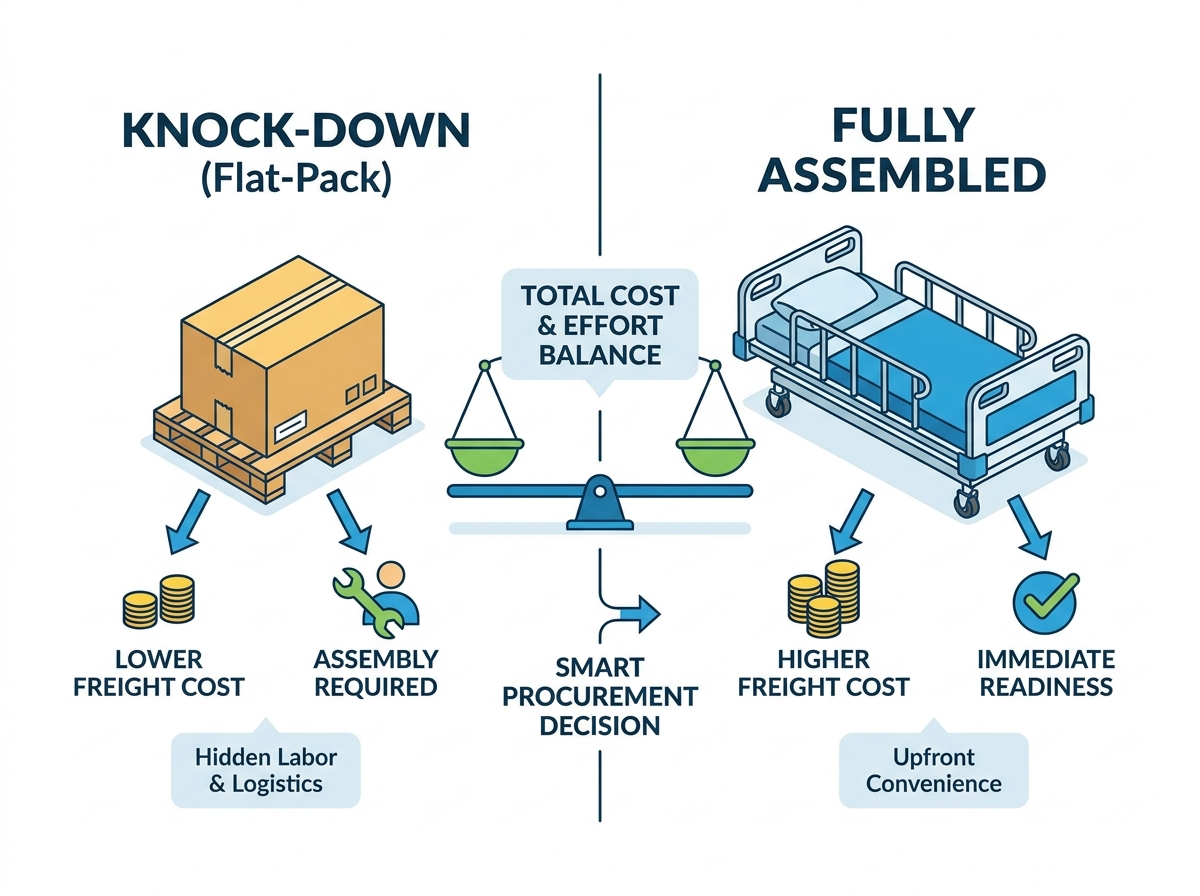
Shipping large furniture items flat-packed alters freight class designations, which drives down transport rates. Buyers must weigh these immediate freight savings against the delayed operational readiness of having to build the units on-site. Fully assembled units arrive ready for immediate patient use, but they command higher shipping premiums due to the immense volume they occupy inside a commercial trailer. By choosing the knock-down route, you trade upfront capital savings for internal labor hours.
Unassembled frames, delicate actuators, and control modules need robust protection during transit. Commercial-grade packaging should feature reinforced wooden crating, heavy-duty corrugated board, and reliable moisture barriers. This dense shielding protects vital electronics and moving parts from constant vibration, humidity changes, and compression during long-haul transit. When you inspect incoming freight, look for impact indicators and ensure the strapping remains tight. Loose packaging often signals potential hidden damage inside.
When leveraging vetted medical equipment OEM services for bulk procurement, buyers should review standard operating procedures for palletizing. Proper container load optimization prevents transit damage and ensures uniform unloading at your dock. High-quality manufacturing partners understand how to distribute weight evenly across a pallet, ensuring that heavy steel frame components do not crush lighter plastic headboards or sensitive electrical junction boxes.
Buyers must explicitly specify the exact delivery tier they require during the quoting phase. Standard Curbside Delivery or Dock Delivery implies the driver simply unloads the pallet at the loading dock or street curb. You assume all responsibility from that point inward. Threshold Delivery means the carrier moves the pallets just inside the first dry, secure area of your building, requiring clear primary access. White-Glove Service offers complete inside delivery to the designated room. Technicians perform full assembly, test the functions, and remove all dunnage. This premium service carries a higher price but heavily mitigates labor constraints.
Delivery Tier Comparison Chart
| Delivery Tier | Included Services | Buyer Responsibility | Cost Impact |
Standard Curbside | Drop-off at dock or curb | Moving inside, full assembly, debris disposal | Lowest upfront cost |
Threshold Delivery | Placement inside first dry area | Room transport, full assembly, debris disposal | Moderate surcharge |
White-Glove Service | Room placement, assembly, debris removal | Final inspection and sign-off only | Highest premium fee |
The Pre-Delivery Spatial Audit: Mitigating Implementation Risks
Establishing standard measurements for all access routes is a mandatory pre-order step. Most unassembled components fit easily through standard doors, but the boxed dimensions can still be incredibly bulky. Unboxed frames generally require minimum doorway clearances between 36 and 42 inches. Check model specifications closely before confirming any order. We recommend adding at least two inches of buffer space to account for the pivot angles required when moving heavy boxes by hand.
Auditing hallway turning radii, stairwell dimensions, and elevator capacities prevents logistical bottlenecks. Freight elevators must accommodate both the physical depth of the long pallets and their substantial weight. Standard passenger elevators frequently lack the depth necessary for full-length frames. Completing this path-of-travel audit prior to dispatch keeps arrival day smooth and predictable.
To perform a successful spatial audit, follow these organized steps:
Measure the exact width of all external receiving doors.
Calculate the turning radius of any sharp hallway corners along the route.
Verify the maximum weight capacity and interior dimensions of your elevators.
Map out a dedicated staging area for unboxing and parts inventory.
You must allocate adequate floor space specifically for the assembly process. Workers need room to maneuver heavy steel frames without risking injury. You must also guarantee sufficient clearance for safe operational movement once built. Ensure the equipment can raise, lower, and articulate its side rails fully without striking walls, monitors, or nearby medical equipment.
Document site conditions thoroughly and share these details directly with your vendor or freight partner. This proactive communication prevents aborted deliveries. Rejected shipments routinely incur substantial return freight charges and punitive restocking penalties. A simple conversation about limited driveway access can save thousands in logistics penalties.
Decoding True Delivery Costs and Hidden Surcharges
The baseline shipping quote rarely covers complex or non-standard delivery scenarios. Buyers frequently encounter hidden logistics costs if they do not ask precise questions. These accessorial fees include residential delivery surcharges, liftgate fees, and limited-access facility fees. You must identify these variables early in the purchasing cycle. For example, a liftgate is absolutely mandatory if your facility lacks a raised loading dock, as drivers cannot lower a 300-pound pallet by hand.
Shipping via less-than-truckload (LTL) networks impacts the unit economics of a knock-down order. Ordering three units might incur a similar flat LTL fee as ordering one, heavily diluting the per-unit shipping expense. Facilities should optimize order quantities to maximize available pallet space. Carriers base LTL pricing on freight density and classification, meaning dense, flat-packed items ship far more efficiently than fully assembled counterparts.
Calculating the true acquisition expense means looking strictly past the baseline invoice price. You must add the base product cost, all accessorial logistics fees, and the internal hourly labor required for unboxing and assembly. By mapping out these three distinct pillars, you uncover the genuine financial impact of the procurement. This ensures your initial budget requests align with operational realities and protects your bottom line from unexpected post-delivery invoices.
Common Mistake: Failing to disclose limited access hours to the freight carrier. If a truck arrives during your facility's quiet hours or after the receiving team leaves, carriers charge redelivery fees. Always specify exact receiving windows on your purchase order.
Unboxing and Assembly Realities for Knock-Down Models
Establishing realistic timeframes for construction keeps facility maintenance schedules on track. A standard two-function manual hospital bed may take 30 to 45 minutes for an experienced maintenance technician to build. Conversely, fully electric bariatric models demand multiple personnel, specialized lifting tools, and significantly more time. Assess your internal labor pool honestly before assuming your staff can handle a bulk delivery of fifty units in a single afternoon.
The critical first step of any unboxing standard operating procedure (SOP) is cross-referencing the packing slip with physical components. Perform this audit before initiating any assembly steps. Discovering a missing bolt, lost caster, or damaged actuator halfway through the build causes frustrating mid-process delays. Keep small hardware categorized in bins during the unboxing phase to prevent accidental loss amid discarded packaging.
Following a strict assembly sequence ensures long-term structural integrity. Adhere to these critical assembly checkpoints:
Secure frame alignment and test all caster locking mechanisms for smooth engagement.
Manage motor connections and route cables meticulously to prevent pinching during articulation.
Conduct thorough hand-crank testing for manual configurations to ensure smooth mechanical lifting.
Confirm proper headboard and footboard structural seating to avoid rattling or instability.
Implement rigorous post-assembly testing protocols before allowing any patient placement. Perform comprehensive load testing by placing weights on the mattress platform. Articulate all electronic or manual functions to their maximum extension. Finally, physically verify side-rail latch security to prevent accidental drops. A meticulous safety check prevents liability issues and guarantees immediate readiness for clinical use.
Procurement Criteria: Vendor Trust and Aftermarket Support
Verify exactly how self-assembly impacts the manufacturer's warranty. Trustworthy vendors clearly define the boundaries between "improper assembly" and true manufacturing defects. Ensure your technicians document their assembly steps, perhaps taking photos of completed wire harnesses, to protect warranty coverage. Ambiguous warranty terms leave buyers vulnerable if a motor fails six months post-installation.
Assess whether the vendor or their logistics partner offers end-of-life removal services for your existing fleet. Proper disposal often involves strict environmental compliance costs, especially for older electronic components and hazardous batteries. Bundling new delivery with old equipment removal can streamline operations and solve two logistical headaches simultaneously. Clarify if removal requires the old equipment to be dismantled prior to pickup.
Shortlist vendors who provide transparent Service Level Agreements (SLAs). Look for guaranteed delivery windows, verifiable freight tracking, and readily accessible technical support during the assembly phase. Having an expert available by phone can quickly resolve complex assembly hurdles. A vendor who disappears after sending the tracking number provides zero value when your maintenance team struggles with a confusing wiring diagram.
Best Practice: Always request a digital copy of the assembly manual prior to purchase. This allows your facility engineering team to review the required tools, assess the complexity, and confirm they have the right personnel to complete the job safely.
Conclusion
Opting for knock-down configurations offers compelling freight savings but demands rigorous site preparation, careful logistics planning, and competent internal assembly labor. The upfront discount only proves valuable if your team can efficiently receive, stage, and build the equipment without disrupting daily clinical operations. Balancing these elements dictates the ultimate success of your procurement cycle.
As a next step, facilities should finalize exact access measurements for their receiving areas and audit internal maintenance labor capacity. Before finalizing any bulk order, request itemized freight quotes that explicitly include necessary accessorial fees like liftgate or threshold services. By preparing your space and setting clear delivery expectations, you guarantee a seamless transition from boxed freight to functional patient care equipment.
FAQ
Q: How long does it typically take to assemble a knock-down hospital bed?
A: A standard manual model usually takes 30 to 45 minutes for one experienced technician. Complex electric or heavy-duty bariatric models require 60 to 90 minutes and at least two people due to heavy component weights and intricate wiring.
Q: Does assembling the bed ourselves void the manufacturer's warranty?
A: Not necessarily. Most reputable vendors cover parts under warranty regardless of self-assembly, provided you follow the official instruction manual. However, damage caused directly by improper assembly, cross-threading, or missing hardware is typically excluded.
Q: What happens if the packaged bed does not fit through my designated doorway?
A: If a palletized unit cannot pass through your access routes, you must unbox it in a larger staging area and carry individual components inside. Rejecting the delivery entirely usually results in carriers charging heavy return freight and restocking fees.
Q: How do shipping costs differ between a standard manual bed and a heavy-duty bariatric bed?
A: Bariatric models use reinforced steel and heavy-duty motors, substantially increasing shipping weight and freight classifications. This extra mass often bumps the shipment into a higher pricing tier, whereas standard manual frames ship lighter and cheaper.
Q: Are tools included in the knock-down packaging, or do we need to supply our own?
A: Basic hex keys and thin wrenches occasionally come inside the box. However, we highly recommend supplying your own commercial-grade socket sets, screwdrivers, and rubber mallets to ensure proper torque and speed up the build.

Get our 2026 Product Catalogue & Book a VIP Meeting
Leave your contact information and our online customer service will contact you shortly.
Reserve a 15-min VIP Consultation with our Engineering Lead. The number of places is limited.
